Аукцион Bidspirit | The Gemara of the Holy
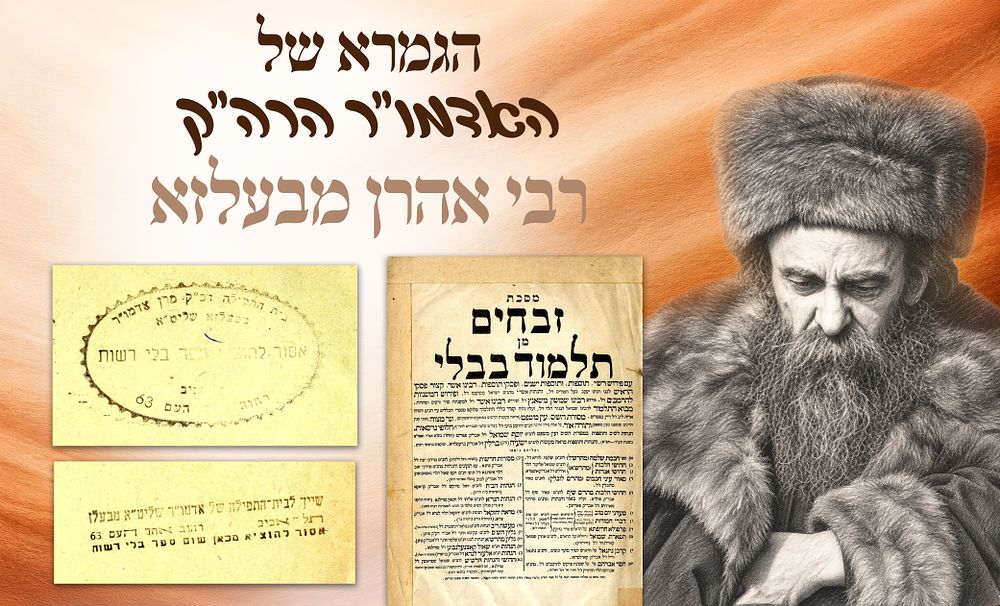
The Gemara of the Holy Rebbe Rabbi Aharon of Belz – From His Beit Midrash in Tel Aviv - Tractate Zevachim from the Beit Midrash of the Holy Rebbe Rabbi Aharon of Belz in Tel Aviv – Bearing the Stamps of His Beit Midrash at 63 Ahad Ha’am Street – A Gemara in Which the Rebbe Studied Torah Tractate Zevachim with commentaries. Pardes Publishing House, New York. The front flyleaf bears two stamps attesting to the volume’s ownership by the Rebbe’s Beit Midrash: “House of Prayer of His Holiness, Our Master, the Admor of Belz, Shlita, Tel Aviv, 63 Ahad Ha’am Street.” And: “Belongs to the House of Prayer of His Holiness, Our Master, the Admor of Belz, Shlita, Tel Aviv, 63 Ahad Ha’am Street.” The Beit Midrash of the holy Rebbe Rabbi Aharon of Belz on Ahad Ha’am Street in Tel Aviv was a tiny shtiebel, possessing an extremely limited collection of books – no more than one or two complete sets of the Talmud (Shas). Consequently, a volume of Gemara bearing the stamps of his Beit Midrash was not merely one among the many volumes of an extensive library, but rather part of the small collection of sacred books available to the Rebbe and those who frequented his Beit Midrash. Considering that the Rebbe’s principal Torah study centered on Gemara, it is reasonable to assume that the present volume lay before him and was used by him for study on numerous occasions. The Rebbe’s extraordinary devotion to the study of Gemara was widely renowned. It is related that before the morning Shacharit prayers, he would review the entire Tractate Berachot at astonishing speed. He was accustomed to saying: “A gantze voch lernt men nor Gemara Rashi.” [Throughout the entire week, one should study only Gemara and Rashi.] He also stated: “Maaseh Rokeach al HaTorah iz pilpulim gag al gag. Der Tate z”l hot gezogt s’iz mesugal tzu simchah; ober a gantze voch zol men lernen Gemara mit Tosafot un Poskim.” [The work Maaseh Rokeach on the Torah consists of intricate layers of Talmudic argumentation, one built upon another. My father, of blessed memory, said that studying it is conducive to joy; however, throughout the week one should study Gemara together with Tosafot and the halachic authorities.] Before us is a sacred Chassidic item of exceptional provenance – a Gemara from the exceedingly limited collection of books belonging to the Beit Midrash of the holy Rebbe Rabbi Aharon of Belz in Tel Aviv; a Gemara in which the Rebbe immersed himself in Torah study, whose pages passed time and again beneath his holy hands, bearing two explicit ownership stamps of his Beit Midrash on Ahad Ha’am Street in Tel Aviv. The holy Rebbe Rabbi Aharon Rokeach of Belz [תר”ם–תשי”ז] was among the greatest tzaddikim and spiritual leaders of his generation, and the figure responsible for rebuilding Belz Chassidism after the Holocaust. His sacred service of Hashem, extraordinary asceticism, and profound devotion to Torah became legendary. Following his miraculous escape from Europe, he established his residence in Eretz Yisrael. For a significant period, he resided in Tel Aviv, where his Beit Midrash on Ahad Ha’am Street became the spiritual center of Belz Chassidim. In an almost supernatural development, entirely disproportionate to its humble beginnings, Belz Chassidism has grown into the enormous and flourishing Chassidic dynasty it is today. Yet during the period when the Rebbe lived on Ahad Ha’am Street, there were barely enough worshippers to form a small daily minyan alongside the holy Rebbe of Belz. Source for the testimonies concerning the Rebbe’s study practices and sayings: Bikedushato Shel Aharon, Vol. I, by Aharon Perlov, Jerusalem, תשס”ז. A tremor of holiness grips one at the very thought that this volume of Seder Kodashim, dealing with the sacrificial service in the Beit Hamikdash and the offering of sacrifices upon the altar, was studied by the “Holy One of Hashem” – the sacred Rebbe Rabbi Aharon of Belz, whose sanctity inspired awe among the great rabbis and tzaddikim of his generation, who proclaimed of him, “Kadosh, Kadosh – Holy, Holy.” After his miraculous rescue from the valley of death, he merited to ascend and dwell in the Holy Land – the land where the Beit Hamikdash once stood and where the sacrifices were offered. Seder Kodashim, in the hands of the holy Rebbe, in the Holy Land!