Bidspirit auction | Manuscript – Hora’at HaEdim VeHaDayanim
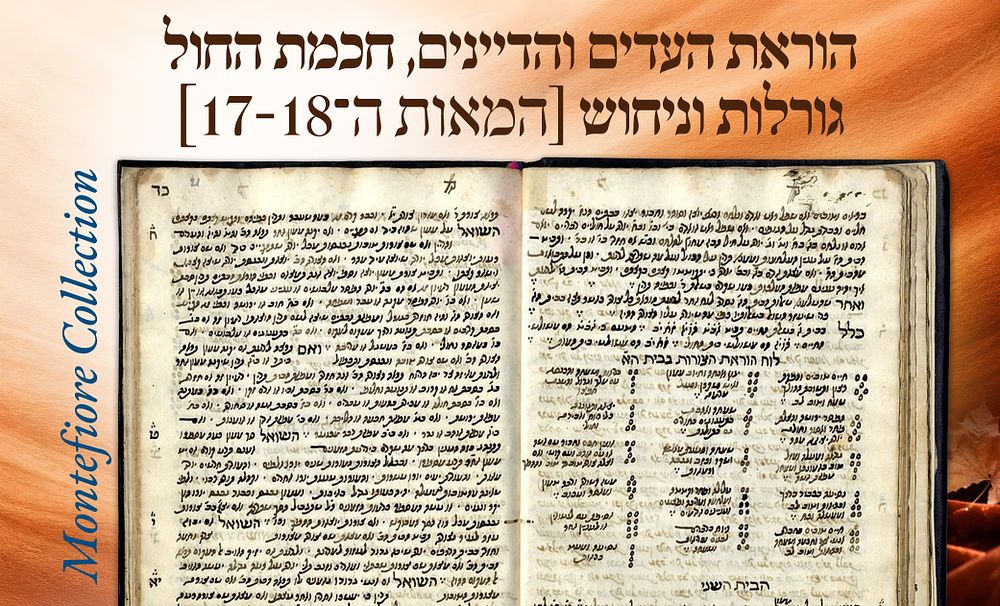
Manuscript – Hora’at HaEdim VeHaDayanim – Geomancy, Lots and Divination – 17th–18th Centuries – From the Montefiore Collection - An Early and Handsome Manuscript containing a collection of works on geomancy, divination, the casting of lots, and various methods of predicting the future. Written in a characteristic Sephardic-Oriental script. The present manuscript brings together works dealing with various methods of casting lots and foretelling the future, particularly geomancy (Chochmat HaChol) – an ancient system based on the formation and combination of figures and signs according to established rules, from which an “indication” or answer to various questions was derived. Among the works in the manuscript is “Hora’at HaEdim VeHaDayanim” (“The Indications of the Witnesses and Judges”), dealing with the system of signs and terminology employed in geomancy. Within this system, the “witnesses” and “judges” serve to evaluate the figures produced and determine the resulting indication. The manuscript includes rules, methods of calculation and interpretation, and combinations of signs, forming part of a literary tradition of divination and esoteric sciences that flourished for generations throughout the lands of the East. On leaves 15a–17b appears a work on geomancy divided into seven – and in practice eight – “paths” or methods. The work is traditionally attributed to Rabbi Abraham Ibn Ezra, who, alongside his celebrated works on Torah, biblical commentary, grammar and poetry, also wrote extensively on astrology and the medieval sciences. In the present manuscript, this section begins partway through the fifth “path.” Leaves 17b–36b contain an additional work dealing with divination, lots, and various methods of foretelling the future. Of particular importance is the colophon at the end of the manuscript. The colophon has been partially damaged by age and worming, but significant portions remain legible: “…and the work was completed… in the month of Iyar… He Who grants man knowledge; I, the young Tzvi, son of my master and father, our teacher Rabbi H.H., of blessed memory…” The name Tzvi is noteworthy in this context, as it was less common among Jews of the East during the period in question. Further investigation into the identity of “Rabbi H.H.” may eventually make it possible to identify the scribe and more precisely determine the place and date of the manuscript’s production. The manuscript is written in a semi-cursive Sephardic-Oriental hand in brown ink. The characteristics of the script point to the Eastern Ottoman sphere – Turkey, Syria, or another community of the East – during the 17th–18th centuries. At present, a more precise place of writing cannot be determined. [108] pages. 240 × 170 mm. Semi-cursive Sephardic-Oriental script in brown ink. Early foliation in ink, accompanied by modern pagination in pencil. The first three leaves are lacking. Moderate-fair condition. The final leaf is reinforced and mounted on paper, with substantial losses. A few repaired wormholes; stains and soiling to the margins. Library stamps [Montefiore] on the first and last leaves. Library cloth binding.