Bidspirit auction | A Highly Important Chassidic Treasure!
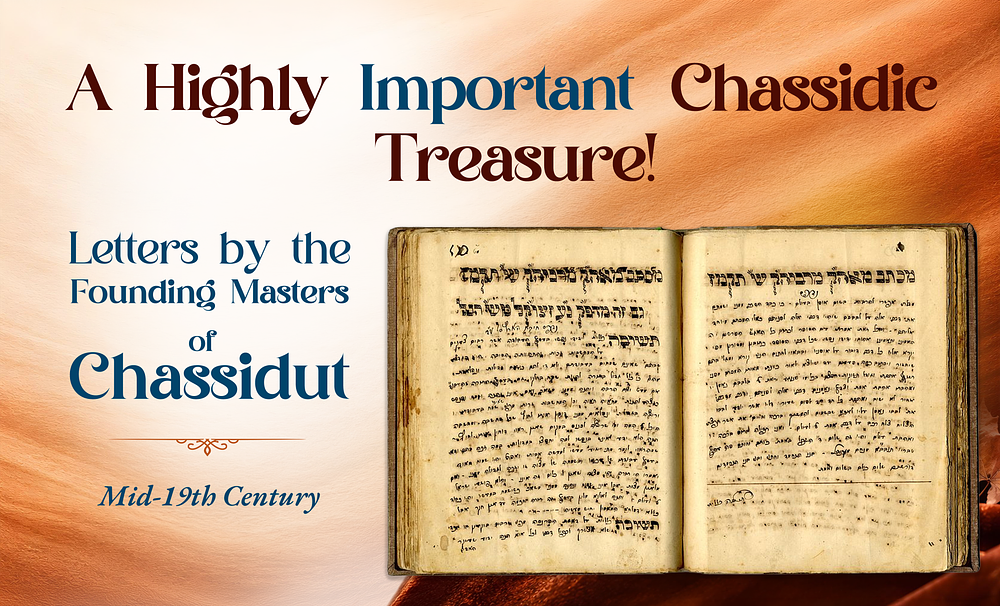
A Highly Important Chassidic Treasure! Manuscript of Letters by the Founding Masters of Chassidut: Rabbi Menachem Mendel of Vitebsk, Rabbi Avraham of Kalisk and the Baal HaTanya – Mid-19th Century - An important and fascinating Chassidic manuscript, written in a generation close to the momentous events surrounding the beginnings of the Chassidic settlement in Eretz Israel, containing an extensive treasury of letters by the early Chassidic masters – foremost among them the holy Rabbi Menachem Mendel of Vitebsk, the holy Rabbi Avraham HaKohen of Kalisk, and the Alter Rebbe, Rabbi Shneur Zalman of Liadi, author of the Tanya. [Eretz Israel or Russia, late 18th–first half of the 19th century, approximately]. The manuscript comprises approximately 170 written pages and constitutes a historically significant collection of copies of letters “from the Holy Land, ” sent in the years following the great Chassidic aliyah of 1777. The letters deal with Eretz Israel, the leadership of the Chassidic community, its connections with the Chassidim in Reisen, and guidance in the service of God. The manuscript was copied approximately in the first half of the 19th century, although the material it contains is earlier: it includes letters dating from 1778–1789. The present manuscript thus represents an early and important link in the transmission of the correspondence of the first Chassidic masters. The present manuscript is of particular importance due to the manner in which the letters from Eretz Israel were transmitted. The letters of Rabbi Menachem Mendel of Vitebsk, Rabbi Avraham of Kalisk and their colleagues circulated for decades in manuscript copies, and only some were printed in the earliest collections: Iggeret HaKodesh (Mezhyriv, 1794), Pri HaAretz (Kopust, 1814), and later Chibat HaAretz (Jerusalem, 1897). The printed versions and surviving manuscripts are not uniform: different collections contain different letters, and even the same letters sometimes exhibit textual variants. Consequently, a substantial manuscript such as the present one is of particular significance, having been copied relatively close to the period of the events and preserving an independent textual tradition of the letters. Indeed, later annotations were added to the manuscript comparing its readings with the text printed in Chibat HaAretz – evidence that already in earlier generations its importance as an early textual witness was recognized. Of particular interest is the fact that Rabbi Avraham of Kalisk and the Baal HaTanya are repeatedly mentioned in the manuscript with blessings reserved for the living, including: “דברי פה קדוש דהר' הק' דק' קאליסק יצ”ו”; “מדבר פה קדוש שליט”א”; “מאדומו”ר גאון עוזינו מו”ה אה”כ שי'[חיה]”; “מאדומו”ר גאון עוזינו מ”ו שניאר זלמן שי'[חיה]”, and similar formulations. These blessings for longevity recur in various places throughout the manuscript, including in headings accompanying the letters. Among the leaves of the manuscript appears an “Ashkavta DeRabbi” relating to the passing of the holy Rabbi Menachem Mendel of Vitebsk in the month of Iyar 1788, alongside letters by Rabbi Avraham HaKohen of Kalisk and Rabbi Shneur Zalman of Liadi written after his passing. This constitutes documentation of one of the pivotal moments in the history of the Chassidic settlement in Eretz Israel. Alongside these three central figures, the manuscript contains additional letters by Rabbi “Moshe son of the Rabbi, of blessed memory”; Rabbi Shlomo Zalman Katz son of Rabbi Tzvi Hirsch HaKohen – “Maharshaz Katz”; Rabbi Aharon Aryeh son of Rabbi Moshe Henles; Rabbi Shmuel Gronem HaKohen; and additional personalities. The manuscript’s Chabad connection is also particularly noteworthy. This is reflected in the titles accorded to the Baal HaTanya, including “Admor Gaon Uzeinu” [“our Rebbe, the Gaon, our strength”], as well as in a passage headed: “Commentary on the holy letter of the brilliant light, our mighty Gaon and Rebbe mentioned above [Rabbi Shneur Zalman of Liadi].” In addition, various indexes to the Tanya of the Alter Rebbe were written at the beginning and end of the manuscript. On one of the final leaves appears the inscription: “מפתחות מבוך ר”ז האבלין”. Specifications: Leaves 1–19, 1–112 [a total of 131 leaves], of which approximately 170 pages are written. Fine, fluent Ashkenazic script, with headings in calligraphic square script. Manuscript dimensions: 240 × 190 mm. Good condition. Age stains. Tiny tears to the margins of several leaves. Inscriptions. New binding. Provenance: The manuscript is documented and digitized by the National Library of Israel, system no. 997011294915205171, under the title “Copies of Letters Concerning Eretz Israel.” The catalog record also notes the indexes to the teachings of the Alter Rebbe appearing at the beginning of the manuscript. The National Library record states that the manuscript is held in a Private Collection.