Leilão Bidspirit | Holocaust — Archive of an
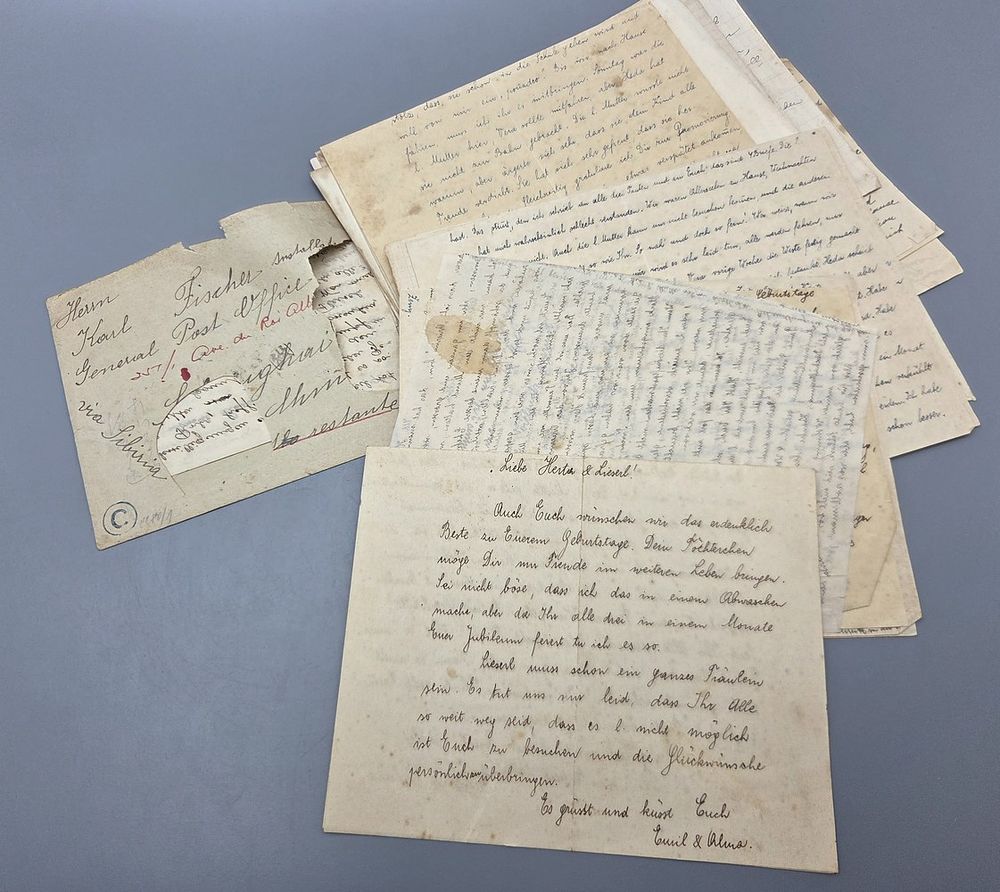
Holocaust — Archive of an Interesting Collection of Letters — Correspondence with Jews from Radomin (Poland) and Vienna (Austria) to a Jew in Shanghai, China — World War II - An archive comprising 19 interesting handwritten letters, sent primarily by Jewish families in Europe — Poland and Austria — from 1939 through 1941 inclusive. Most of the letters were addressed to a Jewish relative residing in Shanghai, China. Also included are letters that were intra-European correspondence among family members. Among them is a letter and envelope sent by a Jew living in the city of Radomin, Poland, via the Third Reich of Germany, passing through the USSR (Siberia), and arriving in Shanghai. This letter is accompanied by its original envelope bearing postal stamps including those of the Third Reich and Chinese postal stamps (stamps cut and missing!). In German. In varying conditions; the majority in good condition with light wear, primarily yellowing, light creases, and fold marks. * The Radom (Radom) Ghetto in Poland was established in March 1941 by the Third Reich-eras; it housed approximately 30,000 to 35,000 Jews and was largely liquidated in August 1942. It was established in the territory of the General Government and was divided into two sections (large and small) within the city of Radom. Most of its inhabitants were deported and murdered at the Treblinka extermination camp in August 1942. The remnant of the camp: approximately 4,000 Jews who remained were transferred to labor camps that operated until July 1944. Thousands of Jewish refugees from Germany and Austria arrived in Shanghai, China, before and during the war (where subsequently, under Japanese influence, a restricted residential zone known as the ”Shanghai Ghetto” was established). International mail to Asia did not exist for Jews who were confined in ghettos in occupied Poland, such as Radom. Those who succeeded in writing and sending letters to China were generally refugees who remained free or were detained in other European countries prior to the years of extermination, and not prisoners within the Holocaust ghettos of Poland. One of the letters before us, from January 1939, which left Poland and passed through Germany — despite the mounting political tension, international postal services were still functioning (World War II broke out only in September 1939) — and mail from Central Europe to China regularly traveled via overland and maritime routes that included passage through Germany and the Trans-Siberian Railway or cargo ships.