Asta Bidspirit | Rare Vocalized Sacred Broadside: ”To
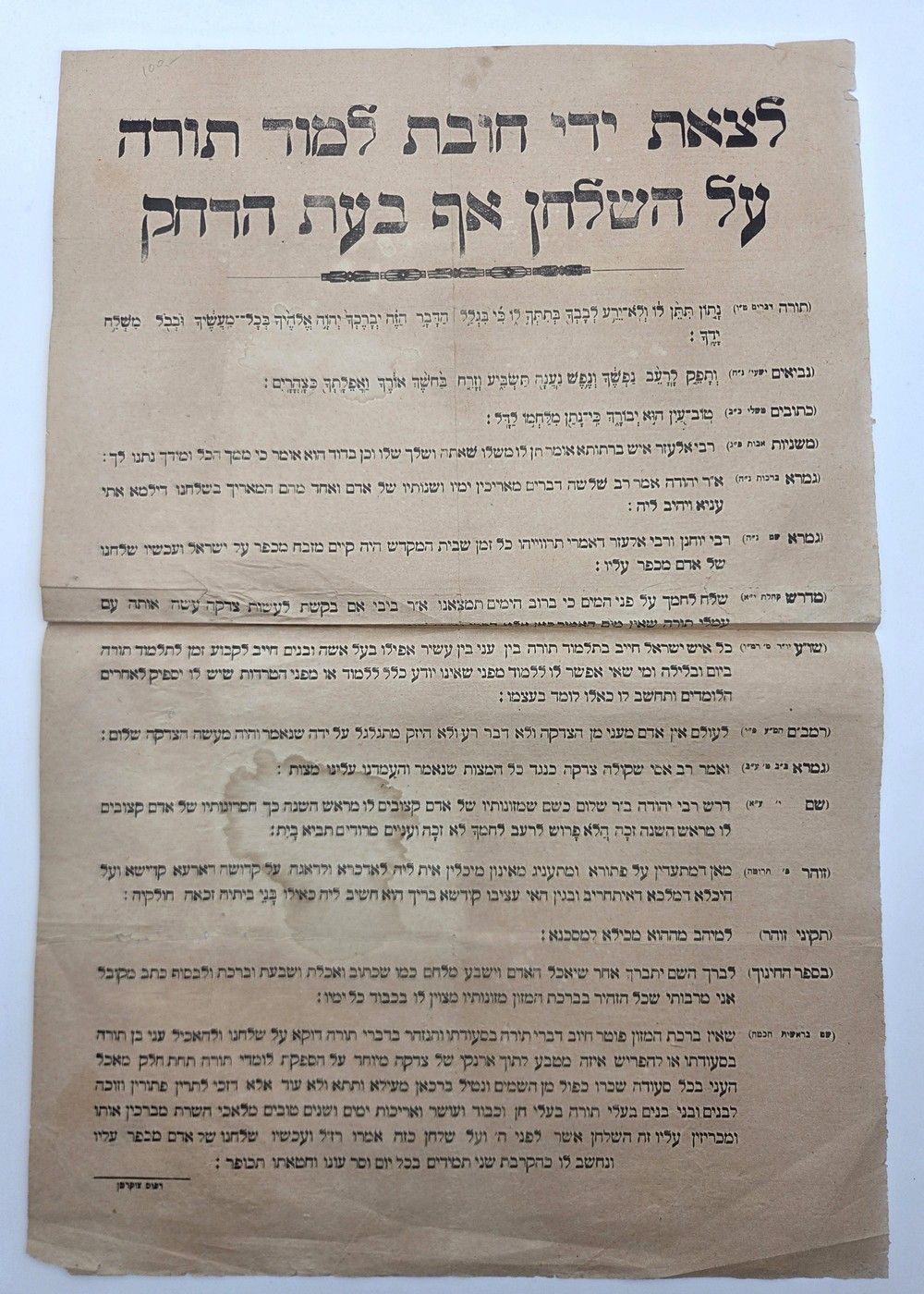
Rare Vocalized Sacred Broadside: ”To Fulfill the Obligation of Torah Study at the Table Even in Times of Hardship” – Jerusalem, Printed by Shmuel HaLevi Zuckerman, Early 20th Century - ”To Fulfill the Obligation of Torah Study at the Table Even in Times of Hardship” – a unique sacred leaf and moral broadside. Jerusalem, late 19th / early 20th century. Printed by Shmuel HaLevi Zuckerman. Hebrew and Aramaic (with full vocalization). Before us is a moral broadside and communal wall poster, designed to arouse the public to fulfill the Rabbinic dictum in Tractate Avot: ”Three who ate at one table and spoke words of Torah over it, it is as though they ate from the table of God.” The broadside assembles, in a careful, structured, and fully vocalized manner, a wide range of Rabbinic sources, Midrashim, and verses from the Torah, Prophets, and Writings (Tanakh), emphasizing the moral, halakhic, and spiritual obligation of Torah study during meals — and the great virtue of the commandment of charity, which protects a person. The anthology includes, among other things, citations and sources from: Torah, Prophets, and Writings: verses from the books of Deuteronomy, Isaiah, and Proverbs. Rabbinic literature and halakha: passages from Mishnah Avot, the Talmud in Tractate Berakhot and Tractate Shabbat, Midrash Kohelet, and the principal halakhic works of Maimonides (Laws of Gifts to the Poor) and the Shulchan Aruch (Yoreh De'ah). Kabbalistic literature: passages from the holy Zohar and the Tikkunim dealing with the sanctity of the table and the prohibition of idle talk or evil speech during the meal. Book of customs: a relevant selection from Sefer HaChinuch and from the book Reishit Chokhmah . 🎨 The leaf was printed in Jerusalem at the well-known press of Shmuel HaLevi Zuckerman, who was among the fathers of modern Hebrew printing in the Old City and in Jerusalem outside the walls. The broadside is designed in an authentic classical Jerusalem typeface: a large, prominent, and bright headline in square letters, while the body text is printed in smaller letters, all fully vocalized with precise vowel points intended for easy and rapid reading at the Shabbat table or on weekdays. The broadside is preserved in relatively good condition for paper items of this period. The text is complete, sharp, and entirely legible throughout the leaf. The paper displays a natural and beautiful patina of age (a natural brownish-yellowish tone), light water stains, and faint original fold marks (the leaf was formerly folded into four sections); no significant tears or damage to the text body. The margins of the leaf are slightly abraded, naturally worn with the wear of old paper. 47 × 31 cm.