Bidspirit 拍卖 | 1840 – Early Uniform Penny
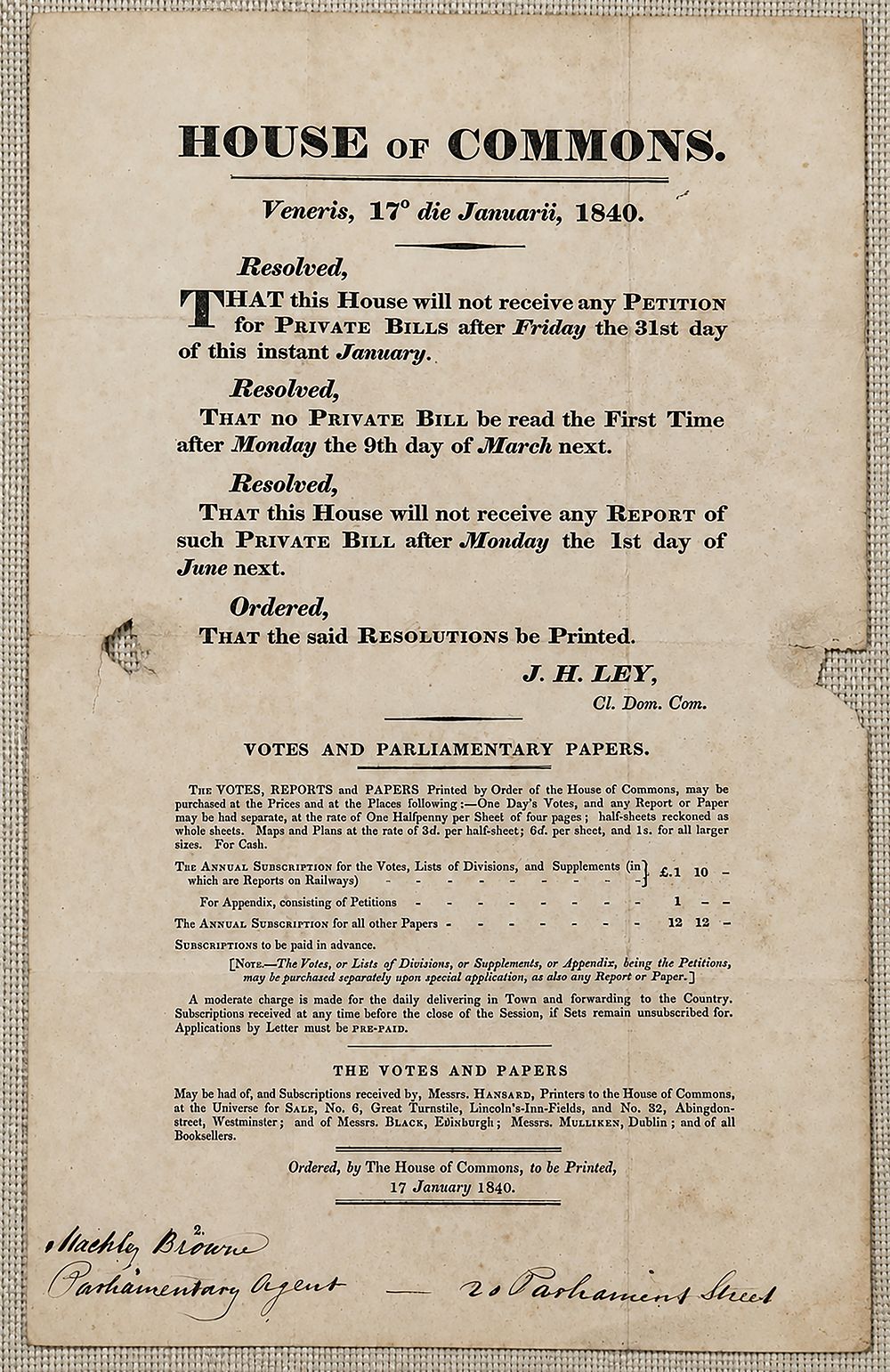
1840 – Early Uniform Penny Post: Official House of Commons Printed Notice Mailed Only Eight Days after the Introduction of Uniform Penny Postage – London PAID & Red Handstruck “1” – 17–18 January 1840 - A rare and particularly interesting piece of early British parliamentary and postal history: an official printed House of Commons notice, dated 17 January 1840, folded and actually transmitted through the post from London to Ulverston, Lancashire, on 18 January 1840. The document was therefore mailed only eight days after the introduction of the Uniform Penny Post on 10 January 1840, one of the fundamental reforms in the history of modern postal communications. The new system introduced a uniform prepaid one-penny rate irrespective of distance. House of Commons – 17 January 1840 The document is headed: HOUSE OF COMMONS. Veneris, 17° die Januarii, 1840. It records official resolutions concerning the parliamentary timetable for Private Bills, including: “THAT this House will not receive any PETITION for PRIVATE BILLS after Friday the 31st day of this instant January.” It further resolves that no Private Bill should receive its First Reading after 9 March, and that no Report on such a Bill should be received after 1 June 1840. The resolutions are printed above the name: J. H. LEY Cl. Dom. Com. The lower portion contains detailed information concerning the availability, purchase and subscription prices of Votes and Parliamentary Papers. At the foot appears the manuscript notation: Mawley, Browne Parliamentary Agent 25 Parliament Street. An Early Uniform Penny Post Usage The postal significance of the item lies particularly in its date. The Uniform Penny Post came into operation throughout Britain on 10 January 1840, but adhesive postage stamps were not yet available. The Penny Black would not enter postal use until 6 May. During this transitional period, prepaid postage was indicated by hand-applied postal markings, commonly in red. The present entire bears a prominent red handstruck “1”, indicating payment of the one-penny rate, together with the red London datestamp: PAID / 18 JA / 1840 / LONDON. Thus, this House of Commons notice, dated 17 January, entered the postal system on 18 January 1840 – only eight days after the beginning of Uniform Penny Postage and nearly four months before the introduction of the Penny Black. Parliamentary Context The date is additionally significant in the history of parliamentary postage. Parliament opened on 16 January 1840, immediately following the abolition of the traditional parliamentary Free Frank privilege under the new postal arrangements. Special prepaid Parliamentary envelopes were introduced at the Houses of Parliament, and the question of penny postage and stamped covers was being actively debated in the Commons on 17–18 January. The present item is not one of those special prepaid Parliamentary envelopes. Rather, it is an official House of Commons printed notice actually transmitted as an ordinary postal entire under the newly introduced Uniform Penny Post system – making it an evocative document of the transition from the old postal regime to Rowland Hill's revolutionary new system. An unusual historical item combining British parliamentary history with the earliest period of Uniform Penny Postage: an official House of Commons document, London PAID marking and handstruck red “1,” used during the remarkable transitional period immediately preceding the world's first adhesive postage stamp.