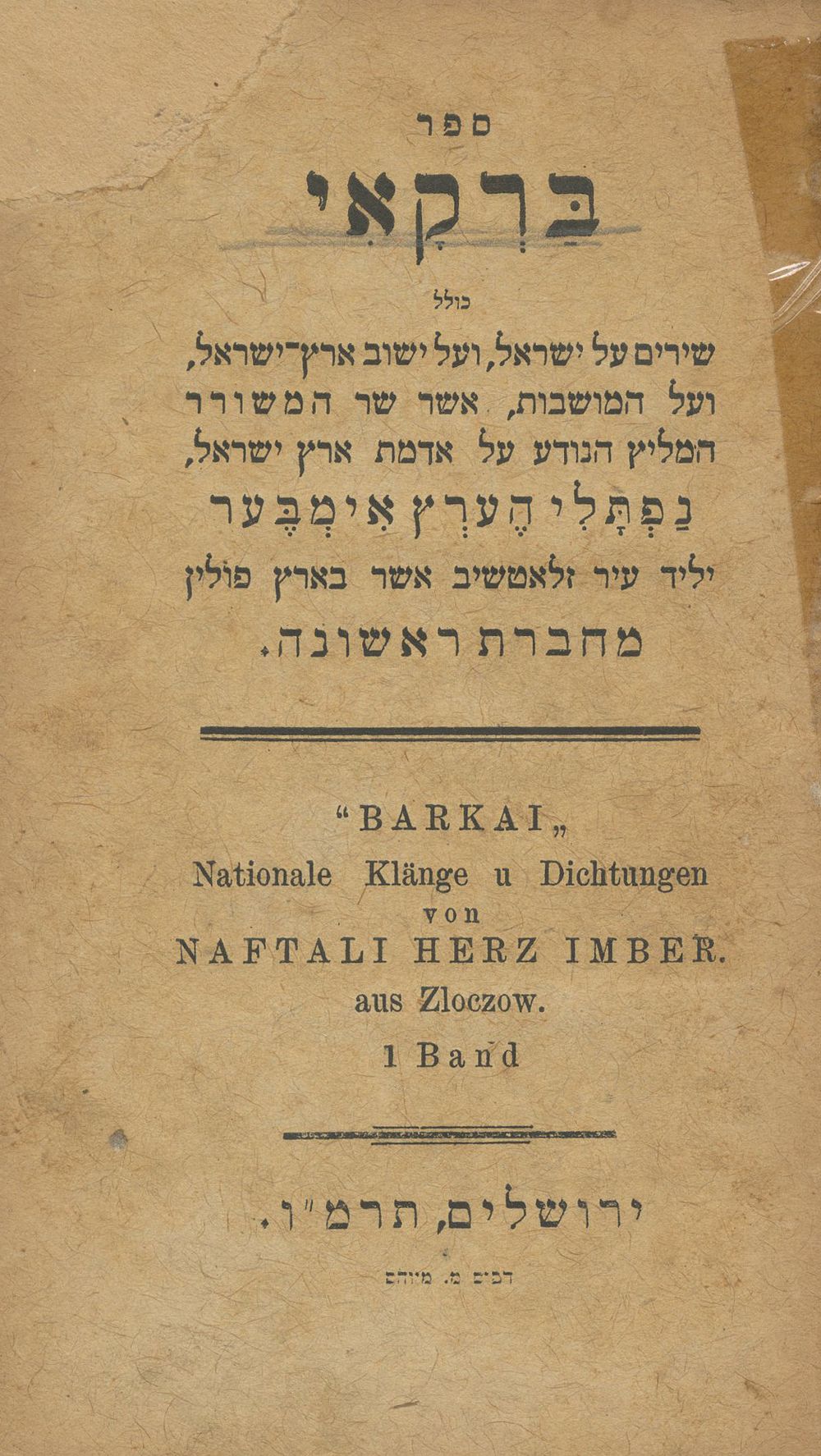
Leilão Bidspirit | Barkai by Naftali Herz Imber
Barkai by Naftali Herz Imber – First Printing of Hatikvah – Jerusalem, 1886 - Barkai [The Morning Star], ”comprising poems about Israel, settlement of the Land of Israel and the moshavot”, by Naftali Herz Imber. Jerusalem: M. Meyuhas, 1886. Hebrew and some German. First collection of poems by Naftali Herz Imber (1856-1909), including his poem Tikvatenu (”Our Hope”), printed here for the first time, which would in time develop into Hatikvah, anthem of the Zionist Movement, and ultimately the anthem of the State of Israel. Includes rare title cover. According to his own account, Naftali Herz Imber wrote the first draft of the poem then known as Tikvatenu in 1877/1878 while he was living in Iași, Romania. A different source, cited by the Encyclopedia of the Founders and Builders of Israel (p. 1586), states that the original words were written in 1886, while Imber was thoroughly intoxicated, having drunk profusely in the course of the Purim festivities at the moshava of Gedera. According to this source, Imber arose from his stupor to declare that he had ”just now composed the first two verses to our national song, which shall give expression to our hope”. Subsequently, while touring the various moshavot of Palestine, Imber altered the words and added stanzas. Eventually, the work was published in its final draft (for the time being) in Imber 's poetry collection Barkai. Roughly a year after the publication of the collection, Shmuel Cohen (1870-1940), one of the young chalutzim (pioneers) of Rishon LeZion, set the poem to an adaptation of a traditional melody with Slavic roots, associated with Romanian coachmen (the Czech composer Bedřich Smetana made use of a nearly identical tune in his symphonic poem, The Moldau). The song was enthusiastically adopted by the settlers of the moshavot. From there it traveled to Europe and was quickly embraced by the Zionist Congresses, to be sung at the conclusion of each session. Over the years, the song was renamed Hatikvah and the Hebrew lyrics gradually underwent a number of changes. The main changes were introduced in 1905, when the line ”to return to the land of our fathers, to the city where David encamped” was exchanged for ”to be a free people in our country, the Land of Zion and Jerusalem” and the words ”the age-old hope” were turned into ”the hope of two thousand years.” Though not officially sanctioned at the time by law or decree, the first two verses of the song became almost universally accepted as the national anthem of the Jewish people. In 1933, Hatikvah gained recognition as the anthem of the Zionist movement. With the establishment of the State of Israel, it was unofficially adopted as the national anthem. This status was not officially grounded in law until 2004. Naftali Herz Imber was born in Złoczów, Galicia (then a region of the Austrian Empire, present-day Zolochiv, Ukraine). He was given a traditional Jewish education up to his teenage years, but while still a youth he embraced the Haskalah movement, and shortly thereafter, Zionism. After wandering through Eastern and Southern Europe, taking on various occupations, in 1882 he chanced upon the Christian Zionist author, journalist, and British Member of Parliament, Sir Laurence Oliphant (1829-1888), to whom he dedicated his book of poetry, Barkai. Oliphant happily took the young poet under his wing, and brought him along when he took up residence in Palestine, where Imber served as his personal secretary. In Palestine, Imber was mostly supported by Oliphant and his wife, Alice. Imber's relationship with the Jewish settlers in Palestine was complex; on one hand, he was filled with profound admiration for the pioneers, spent a great deal of time getting to know the various moshavot, and found many enthusiastic readers for his poetry among the people there; on the other hand, he never ceased to quarrel with the appointed officials of the preeminent patron of the Yishuv, the Baron Edmond de Rothschild. In the Shemitah polemic (1887-89) – a debate surrounding the Biblical commandment requiring farmers to leave their fields fallow every seventh year – Imber sided with the rabbinical establishment, and through his poetry, took issue with the representatives, supporters, and patrons of the New Yishuv, specifically the Baron Rothschild, Eliezer Ben-Yehuda, and Eliyahu Scheid; while he was personally leveled with harsh criticism at the time for accepting money and medical care from his benefactor, Laurence Oliphant, and from various Christian missionaries, he excoriated the Baron's clerks for their corruption and ineptitude. Nevertheless, Imber's stance on these matters was far from consistent; at times he supported the Baron 's personnel, particularly when they catered to his material needs. Following the passing of Alice Oliphant, Sir Laurence left Palestine, and Imber was deprived of his patron. Shortly thereafter, he returned to his wandering lifestyle,