Leilão Bidspirit | Manuscript – Olam Chadash –
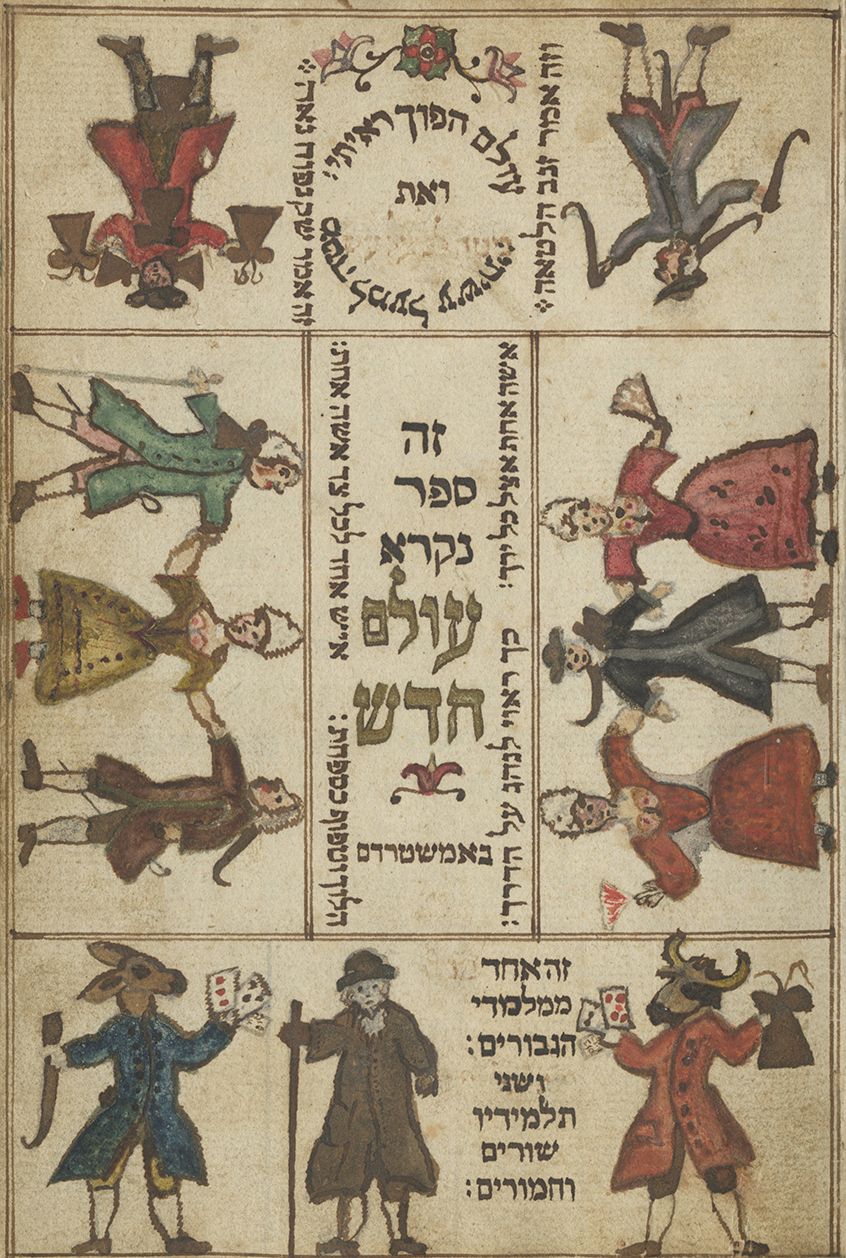
Manuscript – Olam Chadash – Satirical Critique of Secularization – Amsterdam, 1791 – Two Volumes – Illustrated Title Page - Manuscript, Olam Chadash, satirical social critique of secularization in the Amsterdam community, by Yisrael son of Yissachar Ber. [Amsterdam, 1791]. Two volumes. The first volume begins with a color-illustrated title page, featuring male and female figures in fashionable and provocative dress, one of the objects of criticism in the present work. Captions in rhyming couplets next to these characters read: ”one woman next to each thigh should be the practice on the road”, ”two men should strut about like a lesion at each side of a woman”, ”this one says a bulging thigh is pretty, and this one says a lizard's tail”, ”this is one of the heroes' teachers, and his two students are oxen and donkeys”. Both volumes are written in Ashkenazic cursive script, in a fine copying produced by Moshe HaLevi Kontent (based on his colophon at the end of the second volume, see below). Olam Chadash is a polemical satire, the first part of which was authored in Amsterdam in 1772, and the second part at a later date (see below). The work describes, in piercing literary language and in rhyming prose, and from a sharply critical point of view, the penetration of modern European fashion, culture and pastimes into the city's Jewish society: new dress and hairstyles, cosmetics, visits to the theater and opera, mixed dancing, cafés and games, along with contempt for mitzvah observance, abasement of modesty and kosher standards, neglect of Torah study and overall levity towards religious strictures. The work is composed of several parts, including imagined dialogues and comedies. The author parodies familiar texts, making use of kinot, piyyutim, the Passover Haggadah and the like. In his introduction, the author blames the Sephardi Jews for being a bad influence on their Ashkenazi brethren in the city (he calls the Marrano community Onsim rather than the usual Anusim, insinuating a more active role in lapse of observance). He describes their use of secular names and their gentile appearance: ”Their nickname is what they are called by the priest, when they were worshiping barren idolatry, and that's the main thing; but the holy name, which they received newly at their circumcision, is secondary… And when they are called to the Torah, they mix bread with dirt: 'Yaamod Avraham Hendricus, Solomon Santecroos, David Etixerus', and the like, nearly all of which have the impure names engraved in their hearts, a sharp sword at their waists, and a red garment as their dress; old and young grow bangs, and their faces are as smooth as their backsides…”. He claims that they were a corrupting influence on the Ashkenazi Jews who reached Amsterdam after the Chmielnicki massacres: ”The poor who came there from the persecution of Chmielnicki… envied them for their great wealth and unusual deeds, to do as they did… and they followed in their footsteps, merciful women boiled their children, growing their bangs and changing their clothes, with a tail and sackcloth behind them and bright red clothing to wear…”. The date of writing of the work, 15th Av 1772, appears in several places, including the introduction – which includes a notable description of the famous fire that broke out in an Amsterdam theater, killing dozens, including Jewish theatergoers. The author sees the event as a portent and divine retribution. The work begins with a pseudo-halachic query from an individual who seeks to join a group who conduct themselves permissively, dress fashionably, indulge in recreation and disregard Torah prohibitions. The halachic ”responsum” covers most of the first part of the work, and it ”quotes” from the ledger of a man appointed scribe of Gehinnom, documenting all of its residents. The author attacks the adoption of European fashion by Jews (in several places he humorously dates the year by the reigning fashion: ”In the year of the French fashion…”). In several places, the author heaps scorn on the fashionable male dress, hairstyle and shaving, as well as women's provocative dress: ”Some of them walk with a tail and look like a pig and donkey… some wear sackcloth on their shoulders… and the sackcloth is bulging as though filled with lice and fleas… dressed in bright crimson, with a small cap sharp in front and tall in the back like a Frenchman… in black clothing and an English hat…” (leaf 3); ”…his breeches are of Italian silk, and bright red clothing from England, and a wig from Spain, and a small cap from France and a coat from Holland, and seasoned shoes from Suriname, and rings from the East Indies…”; ”…you followed their customs, wearing their dress, in sword, sackcloth and tail to speak their language, and you practiced their religious mores, to do as they do, without a hat on their heads, and thick hair in front of them, and potato flour scattered on them, bareheaded, with a small star under their arms…” (leaf 23);