Leilão Bidspirit | Manuscript, Sermon in Honor of
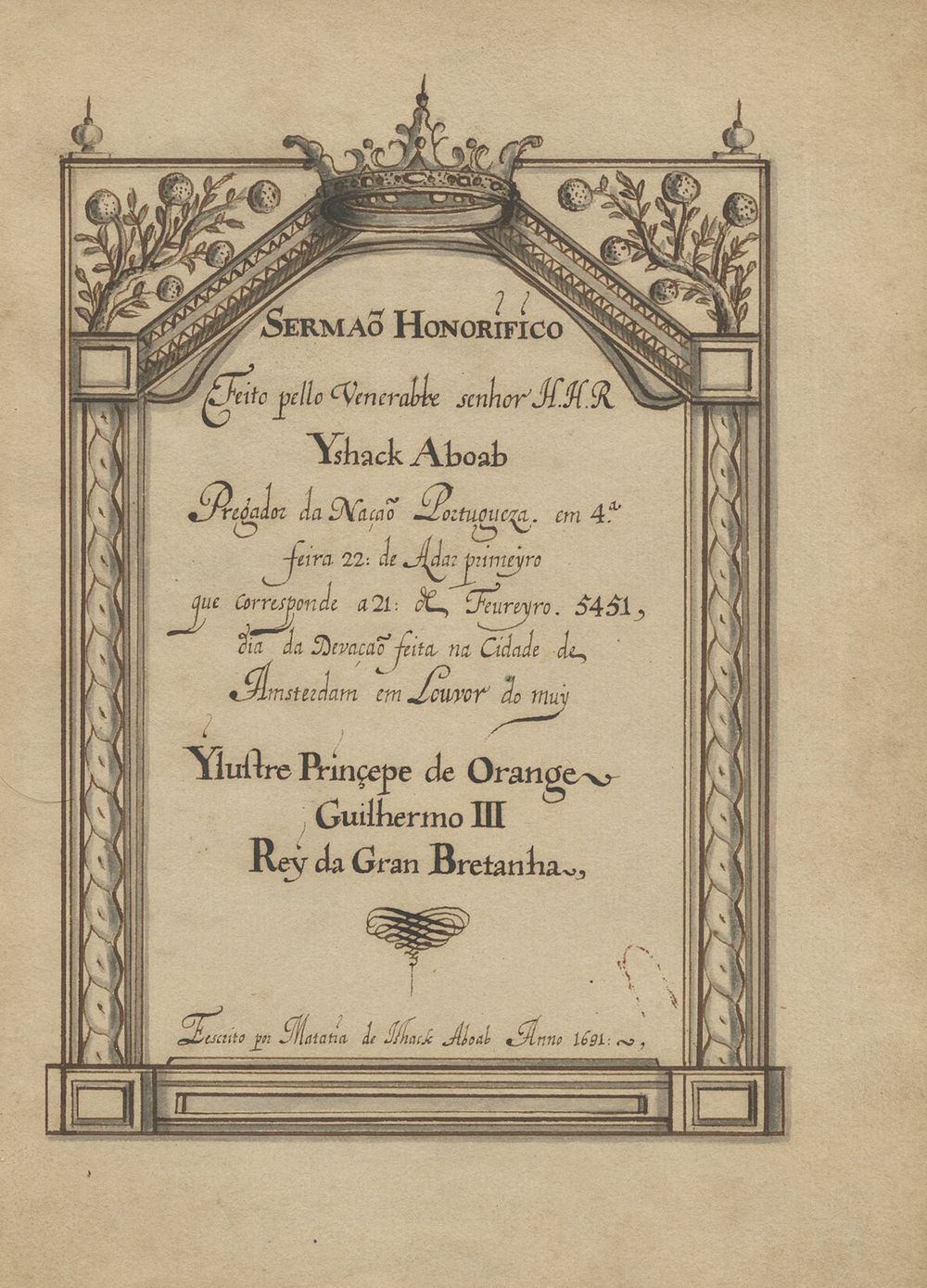
Manuscript, Sermon in Honor of King William III of England – Amsterdam, 1691 – Authored by Rabbi Yitzchak Aboab da Fonseca, First Rabbi to Serve in America – Copied by Calligrapher Rabbi Matitiah Aboab - Manuscript work, Sermaõ Honorifico – sermon delivered by R. Yitzchak son of Matitiah Aboab da Fonseca, preacher of the Portuguese community in Amsterdam, in honor of William III, Prince of Orange and King of England. [Amsterdam, 1691]. Portuguese (cursive script), with citations in Hebrew and Aramaic. Hand-decorated title page. The sermon was copied in 1691 by the calligrapher Matitiah son of Yitzchak Aboab (1672-1703), a prominent scribe and calligrapher of the Spanish-Portuguese community in Amsterdam in the late 17th century. The sermon was delivered during a day of prayer and thanksgiving held in honor of William III, shortly after his accession to the English crown (in the Glorious Revolution, 1688). In his sermon, the author links the prophecies of Daniel to current events: the deposed James II is compared to King Saul, and William III to King David. He describes the crossing of the River Boyne in Ireland by William's army as a miraculous event, seeing his victory as the herald to the messianic redemption. The sermon reflects the Spanish-Portuguese community's loyalty to the House of Orange and Prince William, who had granted them freedom of religion and economic security. The sermon concludes with the author's call for the community to be faithful to the authorities, closing with a prayer for the welfare of the government and the coming of the redemption. The author of the sermon, R. Yitzchak Aboab da Fonseca (1605-1693) was a rabbi and kabbalist, author and translator, one of the most prominent rabbis of Amsterdam in the 17th century. Born in Portugal, he immigrated to Amsterdam in 1612, where he studied under R. Yitzchak Uziel. At the age of 21, he already served as rabbi in the Spanish-Portuguese community in Amsterdam, a position he held for decades. He was one of the initiators of the establishment of the Esnoga, the Portuguese synagogue in Amsterdam. He served as rabbi of Pernambuco, Brazil (which was then a Dutch colony) from 1642, and was thus the first rabbi to settle and officiate in the Americas, and the first Jewish author there. Following the war between Dutch-Portuguese War and the expulsion of the Jews from Brazil, he was compelled to return to Amsterdam in 1649, where he returned to his position as rabbi of the Portuguese community. He was one of the signatories on the ban against Baruch Spinoza in 1656 and around a decade later, he was one of the supporters of the false messiah Shabtai Tzvi, and a signatory of a letter of thanks that was addressed to him. The copyist, Matitiah son of Yitzchak Aboab (1672-1703), was a skilled calligrapher and artist, a member of the Spanish-Portuguese community in Amsterdam. Son of the patron and merchant Yitzchak Aboab (cousin of the author of the sermon, R. Yitzchak Aboab da Fonseca). He had begun to copy various manuscripts in his early years, including educational and ethical works, as well as a genealogical work on Aboab family history. His fine penmanship is invoked in scholarship as an exemplar of the Jewish-Spanish calligraphic art in 17th-century Amsterdam (see: Emile G. L. Schrijver, On Matatia de Ishack Aboab (1672-1703) and his Calligraphic Art, in: Studia Rosenthaliana, XXVI, 1/2 [1992], pp. 193-201). Matitiah died at the age of 31 in a disastrous shipwreck on the way from Texel to Curaçao. Several other manuscripts he copied are extant, including: Documentos para todo Estado e Ydade, an anthology of practices (Ets Haim Ms. EH 48 D 09); Livro de Nota de Ydade, a genealogical work (Ets Haim Ms. EH 48 E 27), a calligraphic scroll (Rosenthaliana Ms. Hs. Ros. 700); and Libro de 60 Treslados, an anthology of calligraphic samples (National Library of the Netherlands, Ms. 74 G 17). Ownership inscription on back endpaper: ”Dr. J. B. de Pinto, te Gouda” – apparently Dr. Jacob Benjamin de Pinto (1809-1886) of Gouda. De Pinto was an intellectual and theologian, a pioneer of the Baptist movement in the Netherlands in the 19th century. Born to a distinguished Jewish Portuguese family, he was baptized to Christianity in 1841 and led a fierce controversy between the Reformed, separatist and Baptist churches in the Netherlands. [1], [13] pages. Approx. 18 cm. Overall good condition. Light stains and defects. Title page partially detached. Bookplate. Early fabric binding, stained and worn, with tears to spine. Provenance: Collection of Mozes Heiman Gans.