Bidspirit 拍卖 | Torah Shield – Franz Anton
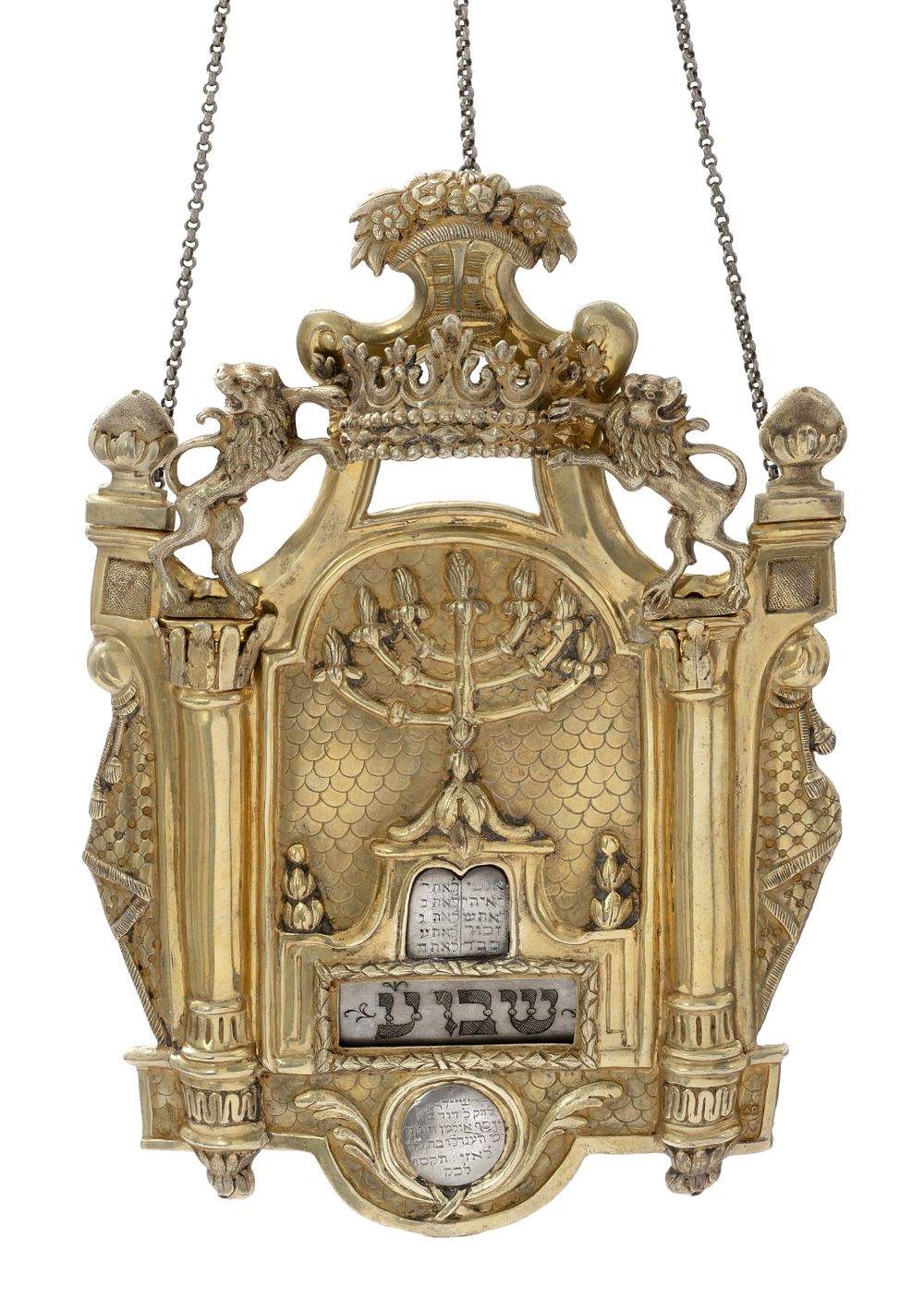
Torah Shield – Franz Anton Gutwein – Augsburg, 1804 – Dedication of Ullman Family - Torah shield. Augsburg, Germany, 1804. Dedicatory inscription dated 1806. Silver, repoussé, embossed and engraved (with Augsburg hallmarks, with date-letter ”P” = 1804 and maker's mark ”AG” for Franz Anton Gutwein); gilt. Impressive, high-quality Torah shield, belonging to a set of shields produced in Augsburg in the late 18th and early 19th centuries in Neoclassical style. Torah shields of this type, produced in the workshops of Augsburg smiths, served as a model for other German smiths, who produced Torah shields inspired by these throughout the 19th century. At the top of the Torah shield is an ornament shaped as a basket of flowers, below which is a crown facing outwards, supported by two lions. At the center are large pillars, with curtain-like decorations, and a large seven-branch menorah, with the Tablets of the Law at the base (engraved with the Ten Commandments). At the bottom is a rectangular compartment for replacement plaques (enclosed are 3 double-sided plaques, apparently original). Below is a medallion with the Hebrew dedication: ”Belongs to David son of Yosef Ullman and his wife Hendele daughter of Lazi, 1806”. The plaque is fully gilt, apart from the Tablets of the Law decoration, replacement plaques and bottom medallion. Original chain. The smith Franz Anton Gutwein was active in Augsburg from 1759-1805. Some 20 Judaica objects he produced are extant, including about a dozen Torah shields, and a number of Torah finials, kiddush cups and havdalah vessels; his work is held in museum collections, including in the Jewish Museum of New York, the Jewish Museum of Amsterdam, the Magnes (Berkeley) Museum and the Israel Museum. For further information and comparisons, see: Grafman, Crowning Glory (New York, 1996), pp. 34-35, nos. 50-58. Height: 27 cm. Width: 19 cm. Weight: 560 g. Good condition. Warping to ornaments at edge and top. Pieces missing from top of right pillar ornament. Bells lacking at bottom and at top opening (behind crown).