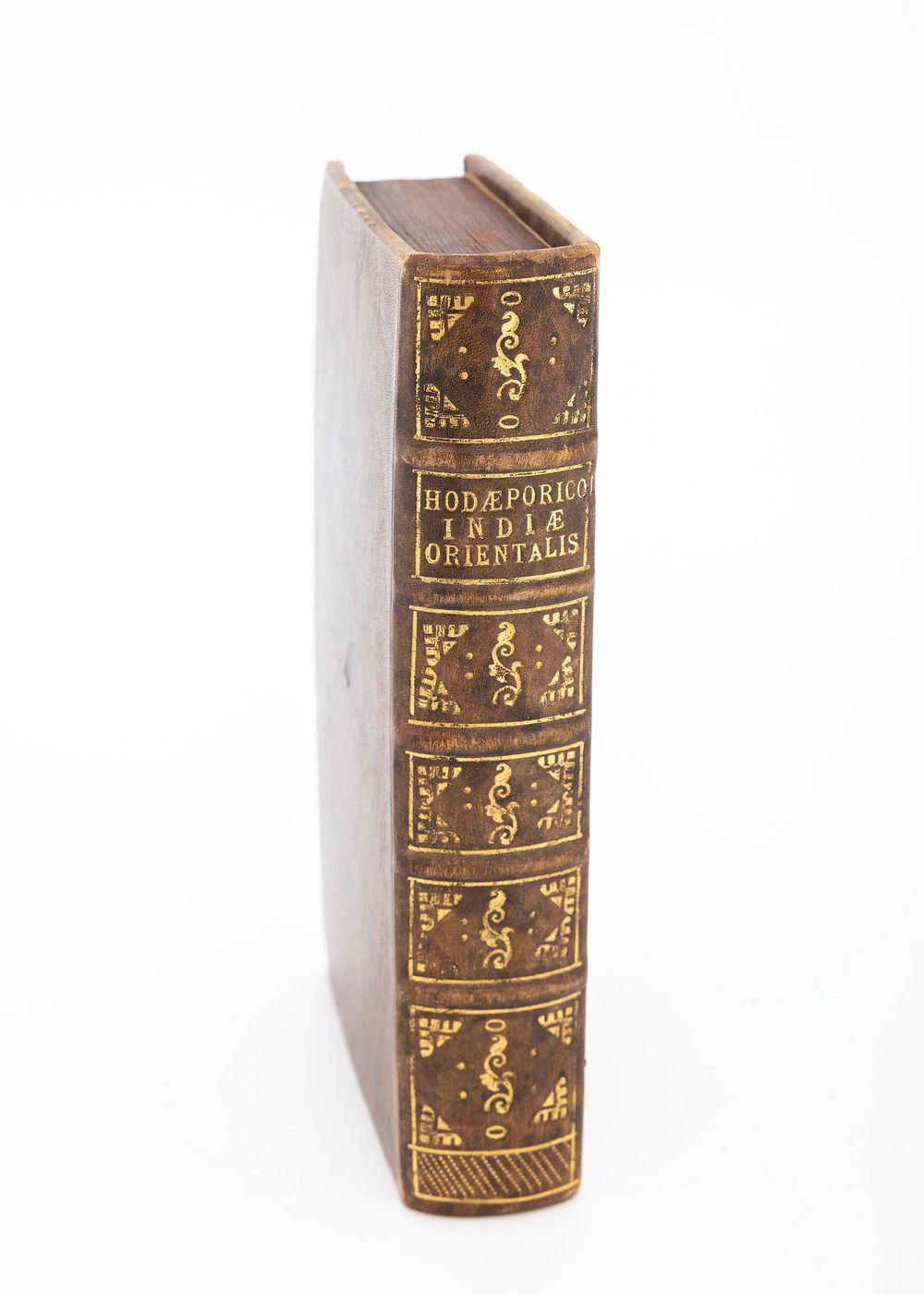
בידספיריט | Hodaeporicon Indiae orientalis; das ist:
Hodaeporicon Indiae orientalis; das ist: warhafftige Beschreibung der ansehlich lobwürdigen Reysz - Hodaeporicon Indiae orientalis; das ist: warhafftige Beschreibung der ansehlich lobwürdigen Reysz (A Guidebook to the East Indies; that is, a Realistic Account of a Most Praiseworthy Journey)Varthema, Ludovico de; Hieronymus Megiser (trans.)Leipzig: Henning Grosse, the younger (Jacob Popporeich; Beerwaldin), 1608. Hardcover. Octavo (14.6 by 8.7 cm): [colon in parens]8 [colon in rev. parens]4 A-Z8 a-b8 c7 (= 219 leaves); [24], 63, 74-402, [22] pp; 18 (of 21) folding copperplate engravings. Title in red and black; lettrines and woodcut ornaments; pagination jumps from page 63 to 74 (text complete); final leaf colophon with woodcut vignette, dated 1607. Text in German. Later marbled calf (lightly rubbed at edges); gilt spine with raised bands; edges stained red. Title mounted and trimmed 2-3 mm along bottom; light to moderate embrowning, with occasional stains; faint dampstain at bottom margin in latter third (just encroaching on text; somewhat heavier on several leaves); cut tightly at top margin, sometimes encroaching on headlines in final 20 leaves. Lacks three folding plates: bird's-eye view of Damascus; inhabitants of Damascus; worshippers at a shrine. Additionally lacks right half of the map of Ethiopia, beyond the fold. A good, though imperfect copy, with eight complete folding maps, and ten folding plates, signed by Henning Grosse, the younger.Rare German edition of Ludovico de Varthema's Itinerario, the sensationally popular and highly influential travel account of his seven-year of journey through Arabia, Syria, Ethiopia, Persia, India, and the East Indies. ”Unlike most of the commentators of the sixteenth century, Varthema went to the East over the land routes of the Levant, learned colloquial Arabic, and acknowledged Islam. He apparently left Venice for Egypt and Syria around 1502, arrived at Cambay in India around October 10, 1504, and then journeyed inland and southward to Vijayanagar, and finally wound up in Calicut [Kozhikode] at the beginning of 1505. He then proceeded southward, rounded Cape Comorin [Kanyakumari] by sea and perhaps then traveled northward along the eastern coast of India.” (Lach). Like his fellow Italians and the Portuguese, Varthema eagerly sought information about the Eastern trade in the wake of the Turkish victory at Constantinople. ”Most of what Europe in general learned about the East during the first half of the sixteenth century, ” as Lach notes, ”related to the spice trade.”Before reaching the Spiceries, however, Varthema passed through the Arabian peninsula. After his arrival in Damascus in April 1503 he joined the Mameluke garrison and then journeyed to Khaybar, Medina, and Mecca. The first European to visit Islam's two holiest cities, Vartherma offers a detailed description of the hajj, the annual pilgrimage to Mecca. It appears that Varthema had at least some knowledge of Muslim prayers and rites. ”His description of the hajj was judged correct by Richard Francis Burton, which suggests that Varthema actually participated in it. The description of the interior of Yemen, which he was probably the first European to visit, is confirmed by that made more than two centuries later by Carsten Niebuhr's Beschreibung von Arabien (Copenhagen, 1772). Therefore Varthema's reliability in the parts of the Itinerario that concern the Arabian Peninsula is not contested” (DBI). His general description of the Hejaz, the western coast of Arabia on the Red Sea, which includes Mecca and Medina, is highly valued as an important source which predates the Ottoman occupation of this region. Varthema also provides the first eye-witness account by a western traveller of the Arabian Gulf region. Our 1608 edition contains complete maps of the Arabian Peninsula and the Gulf, each of which identifies Qatar as ”Catura.”Continuing south, Varthema visited Cambay in 1504. This city on the northwest coast of India receives an especially detailed description in the Itinerario. Vijayanagar, the chief city of a late medieval Hindu empire and the economic and cultural center of south India in the early sixteenth century, is described by Varthema as ”a second paradise.” Pulicat is noted as an entrepôt in the trade with Sri Lanka and Myanmar. Like most travel accounts of the early sixteenth century, the Itinerario describes Kozhikode and the Malabar Coast more than any other part of the East. Writers have, however, long disputed about Varthema's travels east of Kanyakumari, as his descriptions of these regions are generally more vague and inaccurate. According to the Itinerario Varthema touched at several places on the east coast of India and visited Tenasserim (Mergui), Pegu, Malacca, Sumatra, the Moluccas, and Java. He describes pearl fishing in the Coromandel Coast, the jewels of Sri Lanka, along with the sweet oranges of that island (”the best in the world”),