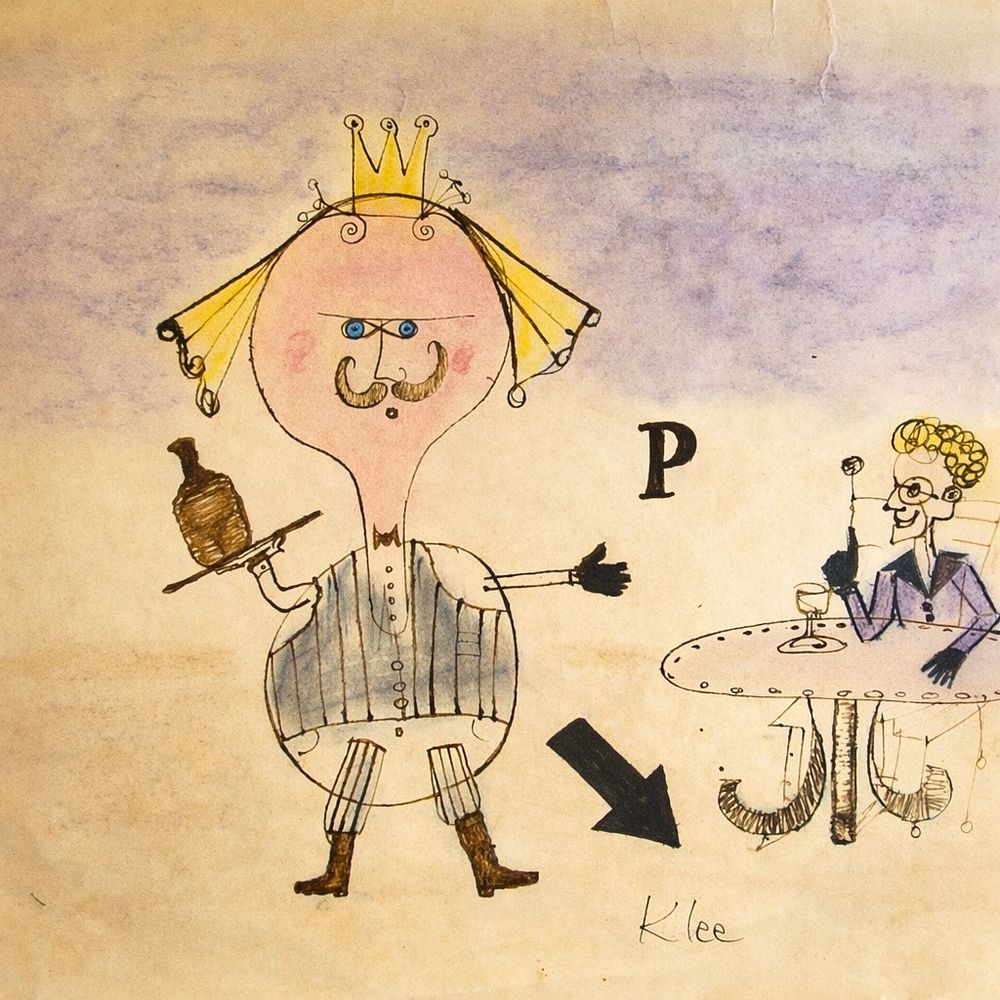
בידספיריט | Paul Klee (1879-1940), Der Kםnig
Paul Klee (1879-1940), Der Kםnig der Franzosen 1925 - Watercolor and ink paper 1925 Signed lower right Dimensions: 25.5x 21.5 cm Provenance: The painting you are referring to is ”König der Franzosen” (King of the French), created by Paul Klee in 1925. Here is the information in English: Visual Description Style: The work is a prime example of Klee's ”linear” style from his Bauhaus period. It features a satirical, mask-like figure of a king, drawn with delicate, spindly lines. Composition: The character is constructed from geometric shapes triangles and arcs that form a face with a long, thin nose and an ironic, almost haughty expression. Technique: Klee often used a unique ”oil-transfer” method or pen-and-ink combined with light watercolor washes. The result is a whimsical yet structured figure that looks like a cross between a puppet and a courtly portrait. alfredflechtheim.com alfredflechtheim.com +1 The 1925 Paris Exhibition The year 1925 was a turning point for Klee's international reputation, specifically in Paris: The Dedication: The name ”Alfred Faber” is likely a misspelling of Alfred Flechtheim, Klee’s primary art dealer. Klee dedicated this painting to Flechtheim as a humorous nod to the dealer's success in ”conquering” the French art market for him. Galerie Vavin-Raspail: In October 1925, Flechtheim helped organize Klee’s first major solo exhibition in Paris at the Galerie Vavin-Raspail. The Surrealist Reaction: The exhibition was a sensation. Leading Surrealists like André Breton and Paul Éluard were mesmerized by Klee's work, seeing it as the perfect realization of ”automatic writing” and the subconscious mind. This event solidified Klee as a ”modern master” in the eyes of the French avant-garde. Fondation Beyeler Condition: For a detailed condition report, please contact: info@hammersite.com