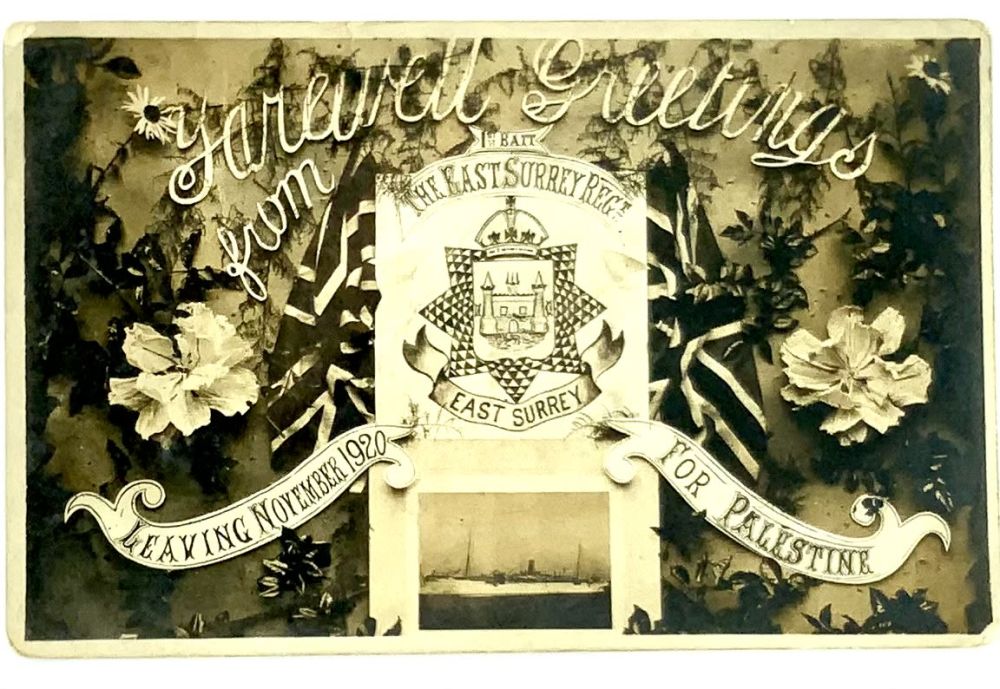
בידספיריט | גלויה פרידה של יחידה צבא
גלויה פרידה של יחידה צבא בריטניה בדרכה לפלשתינה נובמבר 1920. מצב בינוני. 13.5 על 8.5 ס”מ. - This unit was formed in 1881 by merging the 31st (Huntingdonshire) Regiment of Foot and the 70th (Surrey) Regiment of Foot, thereby creating a county regiment for East Surrey. The old regiments were designated the new unit’s 1st and 2nd Battalions respectively. Six militia and volunteer battalions were added. During the unit's first three decades, the two regular battalions were stationed around the British Empire, garrisoning places such as India and Ireland. 2nd Battalion also fought in the Sudan in 1884 and in the Boer War (1899-1902), taking part in several engagements including Colenso (1899), Ladysmith (1899) and Tugela Heights (1900). During the First World War (1914-18), 1st Battalion served on the Western Front. It fought in the battles of Mons (1914), the Aisne (1914), the Somme (1916), Arras (1917) and Third Ypres (1917), before moving to Italy for four months in 1917. It then returned to the Western Front and took part in the Allied advances of 1918. 2nd Battalion served in India until 1915, when it deployed to France. It took part in the Battle of Loos (1915), before moving to Salonika for the remainder of the conflict. The regiment also raised 17 Reserve, Territorial and New Army battalions. These served at home stations, on the Western Front, in Egypt, Mesopotamia and India. Captain RC Sherriff, a winner of the Military Cross, based his 1928 play ‘Journey’s End’ on his experiences of the Western Front with the 9th Battalion. The regiment won 62 battle honours and seven Victoria Crosses during the conflict. After the war, the two regular battalions undertook garrison duties in Britain, Ireland, Palestine , Gibraltar, Egypt, Shanghai, Hong Kong, India and Sudan.