בידספיריט | Exlibris as a form of
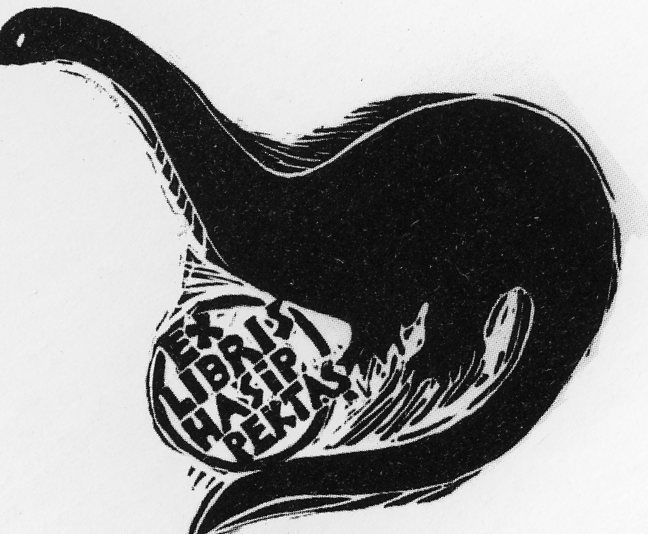
Exlibris as a form of art by Sitki Erink - Exhibition of old-books was opened up at the beginnings of 1960s at Brighton (England) Municipal Building. This exhibition, which I still keep in my memory, happened to be the first and the last book-exhibition I go to see. Unfortunately, I did not run into such an appealing collection from the points of view of printing, material quality, cover set-up and volumezation ever again. Another advantage I gained from visiting this exhibition was getting to know the word ”Ex-libris”. Some imprinted in Latin, some in English, or in another language, these ”Miniature illustrations” affixed to the inner-covers of many of the books inside shopwindows, ofttimes the size of postcards, caught my attention. As separate, distinct entities altogether. 30 years or more have passed since and until I got to see the Ex-libris exhibition announcement to be held at Anadolu University Library Exhibition Center, between 6-16 February, 1996, I realized I had forgotten that I once knew this word. Furthermore, this exhibition was one of my friend's I worked with at the same educational institute, Mr. Hasip Pektas... Mr. Pektas, happens to be a printing artist. I have on occasion studied his works with excitement, whether it be in this area or photographic arts. But his last exhibit was, in my opinion, worthy of special credit from several points of view. This exhibition introduces 'Ex-libris' to absolutely everybody, as few show interest in it and almost nobody besides Mr. Pektas takes it up so professionally. I believe many will, especially many artists who concentrate on drawings, graphic arts, and printing, will want to make use of 'Ex-libris' and will, as a matter of fact, use it. Secondly, this exhibition brings out the concept of 'collection'. 'Collection' is a special field altogether and it displays an individual's preference level, as well as this direction of preferential concentration. The 'Collection', 'Compiling', 'Organizing' interests towards inanimate objects makes an individual more 'picky' with aesthetic selections. At least in the 'field of interest' makes his/her more 'picky'. And finally, this exhibit shows that an artist is capable of presenting his viewers with presentations, relay of messages, proofs, and his experiences and that his artwork is not only for sales purposes. For these three reasons alone, I want to congratulate our young artist, Mr. Hasip Pektas. Besides this, Pektas deserves special recognition from the points of view of the artistic and technical professionalism displayed on this Ex-librises. For over ten years now, we believe it is not an easy task for every person laiming himself to be an ”artist” to lay his heart in an area so far from such materialistic grounds. Ex-libris was first done for performing a task. At the beginnings, it cannot be said to have had artistic qualities. Later on, and especially on European continents after 15th and 16th Centuries on, gained recognition. Ex-libris in Latin meaning ”from ..... library, to ..... library, has from that date on until today, has been a word universally picked up by almost all languages. Maybe we owe Ex-libris to fall beyond this simple performance function, to Albercht DŸrer. As DŸrer's artistic qualities allows for these miniature illustration cards to become aesthetic objects. As many other artists after DŸrer, have exhibited works and Ex-libris through similar techniques, further becoming 'a goal' besides being a 'the means'. Ex-libris's not being interpreted as a lined-up seal, signature, or proof of certification, has naturally changed its' conditions of existence as well as its' performance as such. Conditions of existence can be outlined shortly as; a) it should be a distinct, independent art work. Ex-librises needs to be done using the classical or modern printing techniques. Whether they would be litography wood, metal or linoleum engraving, classical printings or silk screen, photogravure or as on modern computer added design ..... must be produced in definite number and at given qualities. The duplications after this will carry ”reproduction” value. It is inevitable for an Ex-libris to carry on two possessive characteristics at the same time. One reflects the 'artist', the other 'what's done on its' behalf'. This two titles, whether they appear on the same plane, or on separate planes, have the characteristic to carry calligraphic qualities, as types of written statements can be used on Ex-librises. An aphorism, witticism, poetic lines, etc ... must display substantiality or wholeness with these. For these existential reasons alone, an Ex-libris, as it is true of pictures, can be exhibited as a 'printing', distinct (without the book itself) object. b) 'Ontik integrity' and ' completeness' wise, must carry its' artist's name. This name, cannot merely be accepted as a 'simle wording' or a 'signature' ... It symbolizes both its' artist's technical qualities,