Bidspirit auction | Palestine Israel, Zichron Yaakov token,
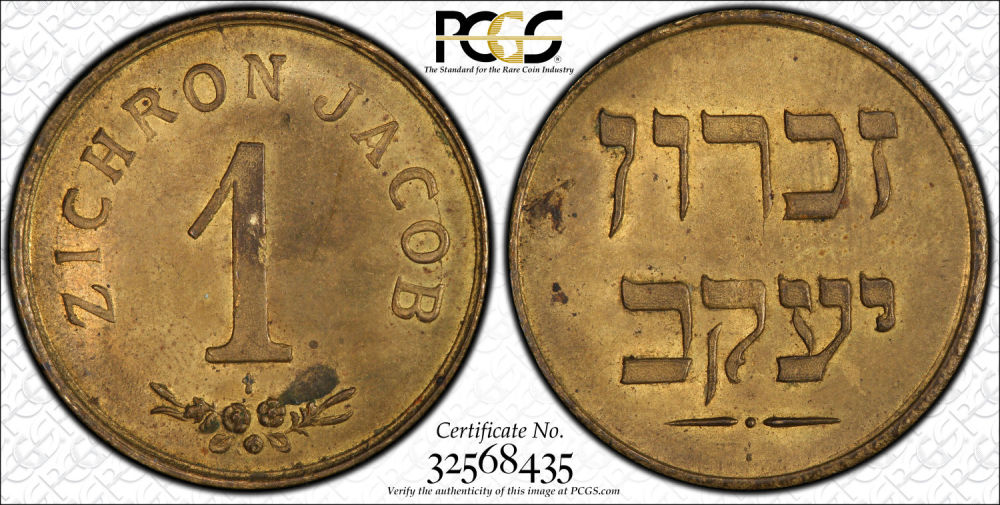
Palestine Israel, Zichron Yaakov token, 1 piaster, 1885, HAFFNER CC-17A, PCGS AU-58 - The Zichron Yaacov village was founded in 1882 by immigrants of the first movement of immigrants to Palestine, ”First Aliyah, ” who arrived on a ship from Romania. First, it was named 'Zamain' after a small agricultural village in this area, from which the land of the settlement was purchased. After about a year of difficulties, the settlers came into crisis and made various attempts to get support. The community members contacted Le Baron Rothschild, who agreed to support the settlement. In 1883 Baron Rothschild inaugurated a synagogue in the village and changed his name to Zichron Yaacov after his father's name. The Baron established a large winery in the community and provided an advanced education and medical network. One of the famous local families in Zichron was the Aharonson family, whose son Aharon was one of the pioneers of agricultural research in the country and, together with his sister Sarah and others, established the ”Nili” underground. In 1885, about three years after Zichron Yaacov was established, the settlement decided to issue tokens for daily use. The person in charge of the mission was Yehuda Wormser, the Baron's representative in the town, backed by 30,000 French francs to finance this project. Denominations of the tokens were 1, 1/2, and 1/4. Intentionally, a unit of value was not stamped on it to not create friction with Turkish law. It is assumed that Yehuda Wormser relied on the Turkish Piaster. In the Turkish financial system, there were two units Piaster and Para. 1 Piaster was worth 40 Paras, so the issued tokens covered the shortage of 10, 20 Para, and 1 Piaster. The tokens were made in Paris, minted in brass in three sizes, with the same backside with the inscription 'Zichron Yaacov, ' below two flat arrowheads with a dot below them in the center. On the other side is the token unit number. From left to right, above the center next to the coin's margins, Zichron Yaacov's inscription. The tokens were also standard in the Arab communities around 'Zichron' and Haifa and Jaffa. After about a year, the Turks realized they had no legal control over the tokens and ordered their destruction.