Bidspirit auction | Order Establishing the Jewish Ghetto
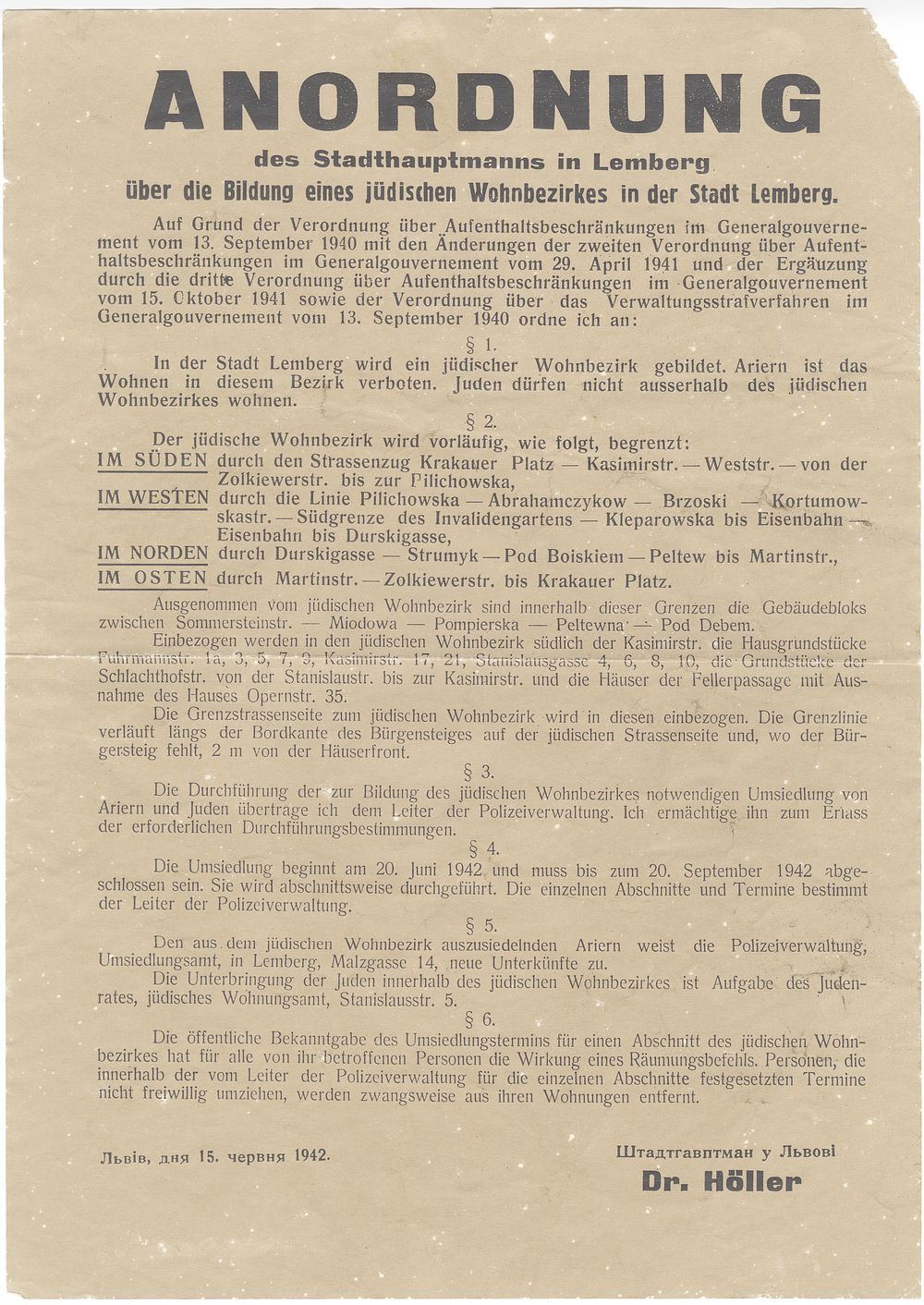
Order Establishing the Jewish Ghetto in Lwów (Lemberg), Published on June 15, 1942 - ANORDNUNG des Stadthauptmanns in Lemberg über die Bildung eines jüdischen Wohnbezirkes in der Stadt Lemberg - ”Order of the City Governor of Lemberg concerning the establishment of a Jewish residential district in the city of Lemberg (Lwów).” June 15, 1942 - the official notice posted in the streets of Lemberg announcing the establishment of the Jewish ghetto. Signed in print by Dr. Höller, City Governor (Stadthauptmann) on behalf of the Nazi occupation regime in Lwów. German with a Ukrainian caption at the bottom. Text of the order: ”A Jewish residential district shall be established in the city of Lwów. Aryans are prohibited from residing in this district. Jews are prohibited from residing outside the Jewish residential district. 2. The Jewish residential district shall, for the time being, be bounded as follows: In the south: by the line of Kraków Square - Kazimierz Street - West Street - from Żółkiewska Street to Pilichowska Street. In the west: by Pilichowska Street - Abrahamczyków - Brzozowski - Kortumowska Street - the southern boundary of the Invalids' Garden - Kleparowska to the railway line - the railway line to Dorskigasse. In the north: by Dorskigasse - Strumyk - Pod Boiskiem - Pełtew to Martinstraße. In the east: by Martinstraße - Żółkiewska Street to Kraków Square. The implementation of the relocation of the Aryan and Jewish populations required for the establishment of the Jewish residential district is entrusted to the Director of the Police Administration. I authorize him to issue the necessary implementing regulations. 4. The relocation of the population shall begin on June 20, 1942, and must be completed by September 20, 1942. It shall be carried out in stages. The individual stages and deadlines shall be determined by the Director of the Police Administration. 5. Aryans evacuated from the Jewish residential district shall be allocated replacement housing by the Police Administration, Evacuation/Relocation Office in Lwów, Melzgasse 14. The accommodation of Jews within the Jewish residential district is the responsibility of the Judenrat, Jewish Housing Office, Stanisław Street 5. 6. The public announcement of the date of relocation of the population for a section of the Jewish residential district shall have the force of an eviction order for all persons concerned. Persons who do not relocate voluntarily within the deadlines established by the Director of the Police Administration for the individual stages shall be forcibly removed from their apartments. [Bottom line in Ukrainian and German] Lwów, June 15, 1942. City Governor of Lwów״ The Lwów Ghetto was the third largest ghetto in occupied Poland (after Warsaw and Łódź). This notice documents the institutionalized and final stage of the confinement of approximately 130,000 Jews from Lwów and the surrounding area within a neglected and overcrowded district in the northern part of the city. In June 1942, concurrently with the publication of this order, the mass Aktionen and deportations from Lwów to the Bełżec extermination camp had already begun. Thousands of Jews were forced to leave their homes and crowd into the small area now defined as the new boundaries of the ghetto. The reduction of the area and the intolerable overcrowding were intended to facilitate the Nazis' removal of Jews for the death transports. The notice was, in effect, an implementation of the Nazis' advancing plan for the liquidation of the ghetto (approximately one year after its establishment in June 1941), after thousands of Jews had already been sent to their deaths at the Bełżec extermination camp and the Janowska concentration camp. Lwów was occupied in June 1941, and a wave of killings immediately began with the participation of local Ukrainians. From July, Jews were required to wear an armband, and a Judenrat headed by Józef Parnas was established. In November, an order was issued establishing a ghetto, and by December its population had reached approximately 120,000 Jews. Once the boundaries were defined, deportations to extermination camps began, with the courtyard of the Sobieski School serving as a selection point, from which those deemed unfit for work were transported via Kleparów station to Bełżec. In the spring of 1942, approximately 15,000 Jews were deported, leaving some 86,000 inhabitants in the ghetto. At this stage, as the deportations to extermination intensified and the ghetto was emptied of Jews, the Nazis decided to reduce the boundaries of the ghetto to half its area and issued the mandatory order before us reducing the territory of the ghetto. Approximately two months later, during August 1942, the ”Great Aktion” was carried out in the ghetto. The Jews were assembled at several collection points in the ghetto; some were selected for labor, while the remainder were shot on the spot or sent in ten transports to Bełżec.