Bidspirit auction | “Deportations” – An Early Testimony
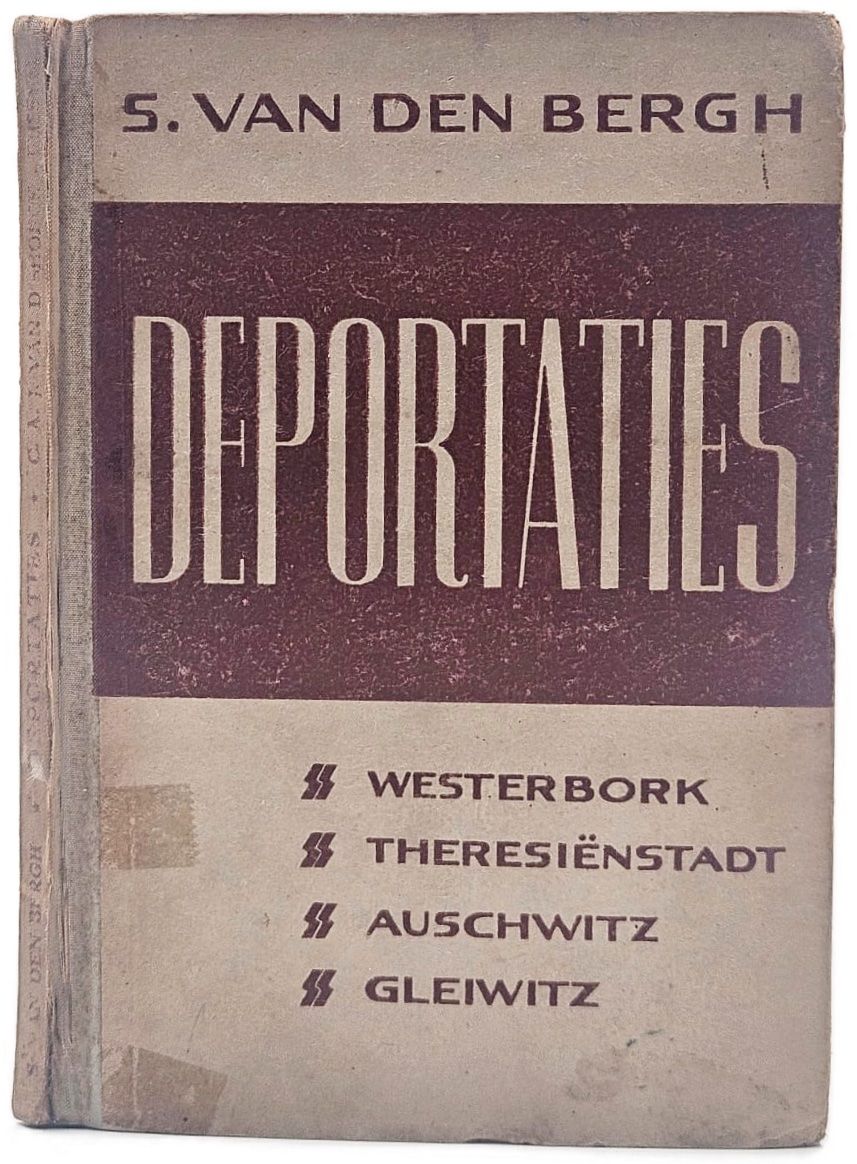
“Deportations” – An Early Testimony by a Dutch Jewish Survivor of the Westerbork, Theresienstadt, Auschwitz, and Gleiwitz Camps. Bussum, [1945] – First Edition - Deportaties. Westerbork – Theresienstadt – Auschwitz – An Early Testimony by Dutch Jewish Survivor S. van den Bergh, Who Survived Four Camps – Westerbork, Theresienstadt, Auschwitz, and Gleiwitz. Published by Uitg. Mij. C. A. J. van Dishoeck C.V., Bussum. Bussum, the Netherlands – First Edition, [1945]. One of the earliest testimonies on the concentration and extermination camps published in the Netherlands immediately after the liberation. Dutch. The testimony of Siegfried van den Bergh [1912–2000], a Dutch Jew who was deported together with his wife, Henriette, to Westerbork, and from there to Theresienstadt, Auschwitz, and the Gleiwitz labor camp. Van den Bergh survived and returned to the Netherlands, and as early as the autumn of 1945 published his testimony. The account begins during Van den Bergh’s work for the “Joodse Raad” – the Jewish Council in Amsterdam – in March 1941, and continues at Westerbork, where he witnessed the transport system at close range. The author worked for the Jewish Council in Amsterdam for approximately two years and was associated with the “Westerbork Staff” department – a group of staff members who were sent to the camp and were permitted to travel back and forth freely. During this period, he and his colleagues effectively served as intermediaries between the Jewish population and the Nazi authorities. He describes attempts to remove Jews from the deportation lists, desperate efforts to postpone transports, and the trains that departed each week carrying entire families. In one of the most harrowing passages, he describes mothers boarding the railway cars with their young children, knowing that at the end of the journey they would arrive at Auschwitz. “My true account of the deportations and forced removals begins in July 1942, when the Germans informed the Jewish Council that it had been decided to ‘employ Jews’ in eastern Germany. A shudder ran through the Jews of the Netherlands. They did not fully understand what the term ‘employment’ meant, but intuitively they sensed that the way had now been opened to the worst... The intention was to transfer all the Jews rounded up in the cities and villages to the camp, and from there to assemble the transports eastward. A chilling secrecy hung over everything. Week after week the transports departed. Tens of thousands of Jews left for eastern Germany and Poland; not a word filtered back, nothing was known of their fate abroad. This secrecy continued until the very end, and only now, after the war, are there a few survivors, such as my wife and myself, who can tell of the horrors in the concentration camps in Poland...”, he writes. Van den Bergh goes on to describe his deportation to Theresienstadt after the Nazis no longer had any use for him, the searches and confiscation of possessions upon arrival, the overcrowding and starvation, the abuse of Jews, life in the ghetto, and a harrowing record of the transports departing eastward – many carrying people he knew personally, whom he mentions by name and whose fate he documents. At the end of September 1944, he and his wife were placed on a transport to Auschwitz. In the chapter Concentratiekampen, he describes the horrific journey in a railway car crowded with some 70 people, the gradual realization that the train was heading toward Auschwitz, and the growing terror among the Jews in the car as their destination became clear. He describes his arrival at Auschwitz: “We were trapped. In the distance we saw women sorting our clothes: trousers with trousers, coats with coats, and so on; it was intended for the German population. We had nothing left; no documents that could prove our identity, no photograph of our family, not a single item of clothing or blanket of our own. Morning had already come when we, naked as we were, were taken into a long hall, where we were ordered to line up in rows of three. Here, the hair on our heads and bodies was shaved off by prisoner barbers. The process lasted many hours... Then came a shower room. Forty or fifty men had to wash there at the same time. No soap, no brush, no towel. Like wet cats... Anyone who looked old or exhausted, anyone who appeared too old to work, all children under the age of fourteen together with their mothers, the sick and the mentally impaired were forced to take the road to death...”. At Auschwitz and Gleiwitz, he documents the operation of the gas chambers and crematorium, forced labor, starvation, disease, and the primitive medical treatment available to prisoners. Van den Bergh describes operations performed with virtually no anesthesia, infected wounds from which prisoners suffered without treatment, and the deaths of many inmates. In January 1945, as the Red Army approached,