Bidspirit auction | Four Issues of the French
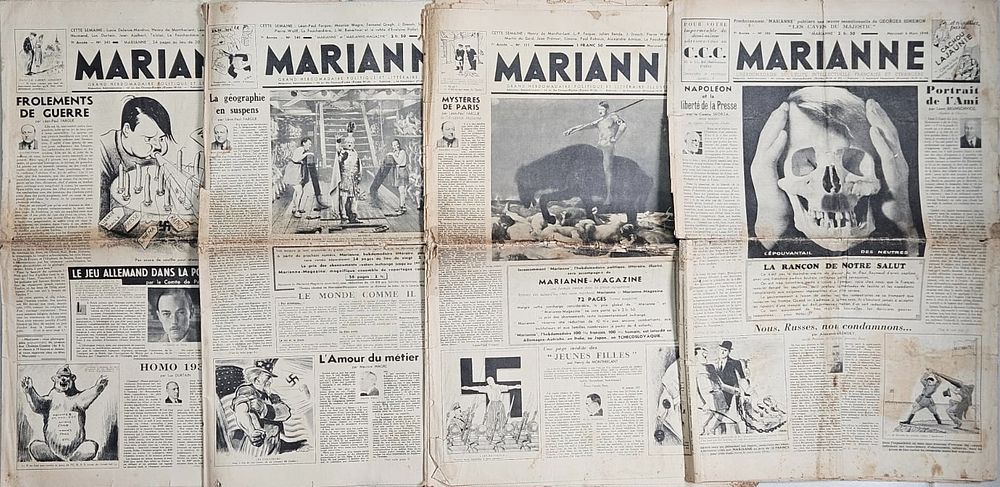
Four Issues of the French Weekly Marianne – Anti-Nazi Caricatures at the Outbreak of World War II, Exposing Adolf Hitler’s True Intentions - Marianne – Grand hebdomadaire politique et littéraire illustré. Four issues of the French political and literary weekly Marianne, Paris, 1939–1940. French. Issues documenting, through caricatures, articles, and photographs, the growing anxiety in France over Nazi Germany during the months preceding the outbreak of World War II and the early months of the war. A rare publication from the final months of free France. Issues: March 22, 1939 April 26, 1939 May 17, 1939 March 6, 1940 The first three issues appeared in the spring of 1939, following the occupation of Czechoslovakia and at a time when German expansion in Europe had become an immediate threat. The fourth issue appeared in March 1940, approximately six months after the outbreak of the war and during the period of the “Phoney War, ” only about two months before the German invasion of France. The present issues feature a series of biting caricatures directed against Hitler and Nazi expansion. In one, Hitler is shown holding chains binding figures labeled Autriche, Tchéc., Pologne – Austria, Czechoslovakia, and Poland. When asked why he does not release these “nations, ” he replies: “Ce ne sont pas des nations, ce sont des espaces vitaux!” – “They are not nations; they are living spaces.” Another caricature depicts Hitler dreaming of a world subjected to Nazism: swastikas appear on the Eiffel Tower, Notre-Dame Cathedral, the Statue of Liberty, the Sphinx, and monuments and symbols of various civilizations. Hitler holds a booklet entitled Mon espace vital – “My Living Space, ” with Mein Kampf beside him. Beneath the illustration is an appeal to the French public to purchase armament bonds so that “his dream may become his nightmare tomorrow, ” and thereby contribute to the defense of civilization. Another caricature depicts the German army facing figures representing French military leaders, with Reich soldiers positioned along the “Siegfried Line.” The ironic caption warns that “it is strictly forbidden to hang laundry out to dry on the Siegfried Line, ” mocking the German system of fortifications and the military tension along the Franco-German border. In another caricature, entitled Les Bienvenus [“The Welcome”], a female figure symbolizing Prague is shown stretched out as if crucified upon an enormous swastika, while Hitler and his soldiers receive her with bayonets – a powerful visual expression of the occupation of Prague and the destruction of Czechoslovakia in March 1939. The cover of the May 17, 1939 issue is likewise devoted to portraying Adolf Hitler’s dictatorship: he is depicted extinguishing, one by one, candles bearing the words Liberté de parole, Presse, Cinéma, Radio, Art, Littérature, Vérité – freedom of speech, the press, cinema, radio, art, literature, and truth. A swastika stands at the center, and the image presents the Nazi regime as systematically extinguishing intellectual and expressive freedoms. The March 6, 1940 issue features on its cover a dramatic image of a skull in the likeness of Adolf Hitler held in a pair of hands, beneath the title L'Épouvantail des neutres – “The Scarecrow of the Neutrals.” It appeared when the war was already underway in Europe, although France and Germany had not yet entered into the major land campaign on the Western Front. Approximately two months after this issue appeared, the German army invaded France; Paris was occupied in June, and in August 1940 Marianne ceased publication. Marianne was founded in 1932 at the initiative of publisher Gaston Gallimard as an illustrated political and literary weekly. During its early years it was headed by the writer and journalist Emmanuel Berl, with Pierre Bost serving as editor-in-chief; André Malraux was involved in its design. The weekly was associated with the moderate French left and provided a platform for a wide range of writers and intellectuals. Alongside literary and cultural articles, it devoted extensive coverage to European politics, and its political caricatures and photomontages became one of the publication’s distinctive features. The significance of the present issues is heightened by the sharp divisions within the French press on the eve of the war. Alongside newspapers and periodicals that warned against Fascism and Nazism, France had a powerful and widely circulated far-right press, some of which expressed sympathy for Fascism, disseminated antisemitism, and even displayed a favorable attitude toward Nazi Germany. Marianne maintained its sharply defined and uncompromising position until censorship was imposed upon it in the summer of 1940, and it ceased publication on August 28. Four complete issues. 57 cm each. Tears and losses along the fold lines, stains, tears, and wear to edges. Moderate condition.