Bidspirit auction | First Publication of the Horrifying
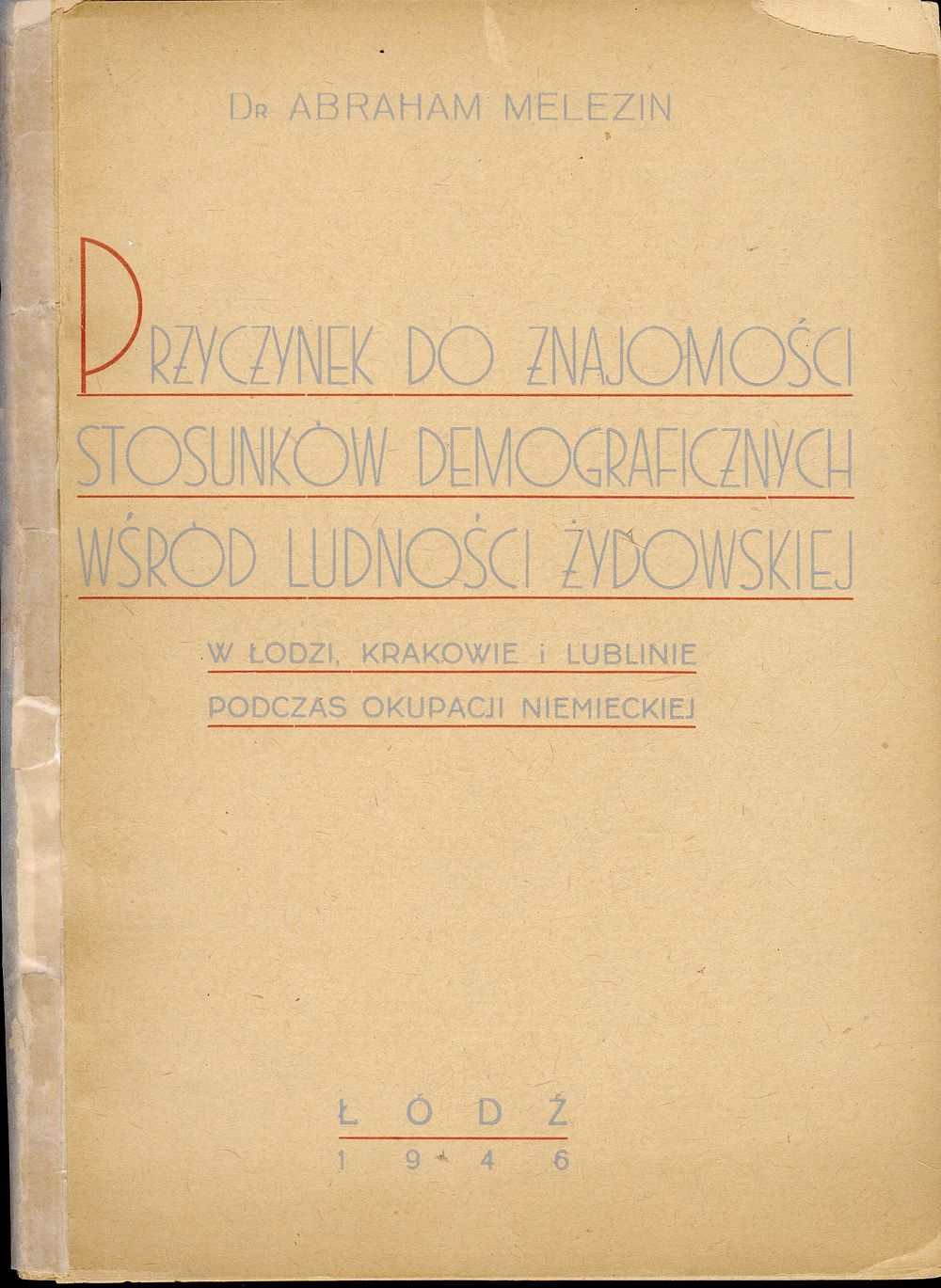
First Publication of the Horrifying Demographic Data Concerning the Jewish Population of Łódź, Kraków, and Lublin During the German Occupation- Łódź, 1946 - First Edition - ”Przyczynek do znajomości stosunków demograficznych wśród ludności żydowskiej w Łodzi, Krakowie i Lublinie podczas okupacji niemieckiej” - ”A Contribution to the Understanding of Demographic Conditions among the Jewish Population of Łódź, Kraków, and Lublin During the German Occupation, ” by the Polish-Jewish geographer and demographer Dr. Abraham Melezin. Published by the Central Jewish Historical Commission in Poland (Centralna Żydowska Komisja Historyczna przy CK Żydów Polskich). Łódź, 1946 - first edition. Polish. Extremely rare. One of the earliest and most important attempts to document and analyze, scientifically and statistically, the demographic destruction of Polish Jewry while the ruins were still smoldering. The Central Jewish Historical Commission, established immediately after the liberation by survivors under the leadership of prominent historians such as Philip Friedman, Nachman Blumental, Michał Borwicz, Józef Kermisz, and Józef Wulf, set itself the task of collecting documents, testimonies, and administrative data in order to document the scale of the tragedy in the cities of Poland. The internal title page and introduction make clear that the research was conducted in cooperation between the Commission and the Institute of Geography at Maria Curie-Skłodowska University in Lublin and was completed as early as November 1945. The book presents a thorough and in-depth analysis of demographic trends in the ghettos and Jewish centers of Łódź, Kraków, and Lublin. The author presents data as precise as was possible regarding changes in the composition of the population, declining birth rates, mass mortality, age and sex structure, changes in the occupational structure, and the appalling overcrowding in the ghettos. With regard to the Łódź Ghetto, the book includes, among other things, a diagram and a detailed table showing the sharp decline in the birth rate alongside the dramatic fall in the number of inhabitants throughout the years of occupation (1940–1944), as a result of relentless attrition, starvation, disease, and deportations to the extermination camps. The section dealing with Lublin describes the Nazis' administrative measures, the extreme overcrowding in the ghetto (including the Majdan Tatarski area), and the steep decline in the birth rate from 1939 until the liquidation of the community, alongside tables detailing the occupational distribution of the ghetto inhabitants. In the introduction, the author adds a human dimension to the statistical facts presented here, noting that the demographic changes during the war followed unique laws that transcended every familiar concept, to the point of a process of rapid extinction even before the institutionalized mechanisms of extermination were put into operation. ”War has its own specific demographic laws, which generally profoundly disrupt normal processes. However, the phenomena we witnessed among the Jewish population go far beyond the general laws established thus far. Some of the demographic processes assumed such proportions that we were faced with the rapid extinction of the Jews, even in the period before the existence of the extermination camps.” He adds that although these data are familiar to the survivors through personal experience and as eyewitnesses to the harrowing events, it is of paramount importance to substantiate them with precise, objective statistical data in order to reflect, objectively and unequivocally, the horrors of the period. The primary source of statistical material for this study was the official statistics collected periodically by the Jewish Councils of Elders in the various cities for use by the German authorities. The author also relied on extensive statistical material found in the correspondence of the Jewish Social Self-Help organization, whose headquarters were located in Kraków during the occupation. In addition, in order to reconstruct the course of events themselves in the various ghettos, the editors drew upon eyewitness testimonies preserved in the archives of the Central Jewish Historical Commission and its branches in the cities under discussion. Extremely rare publication. Only two records in the WorldCat global library catalog. 76 pages. Paper slightly brittle. Tear with minor loss to the corner of the front cover. Spine reinforced with adhesive tape. Good condition.