Bidspirit auction | Russian antique book “Morehodnaya astronomiya”
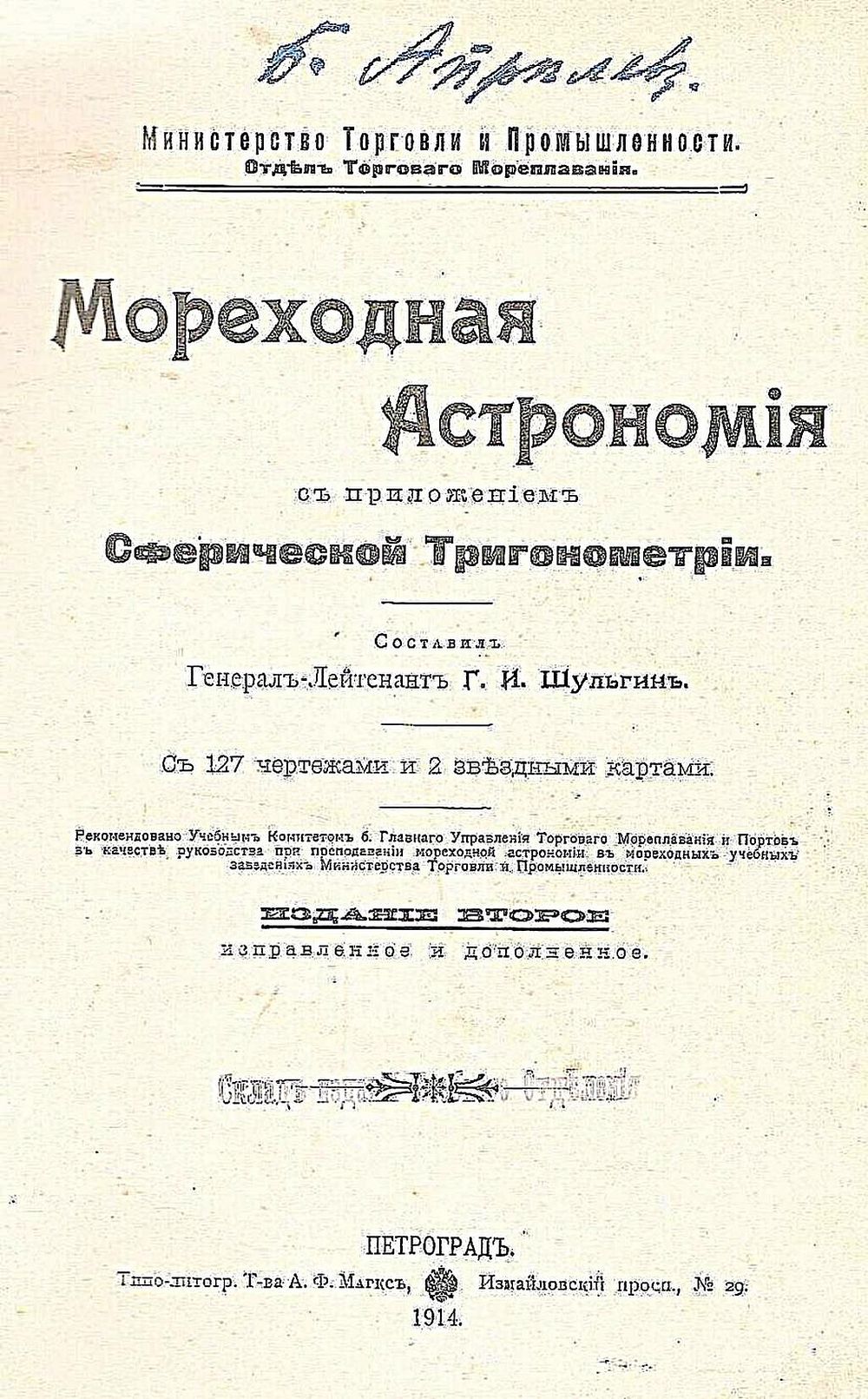
Russian antique book “Morehodnaya astronomiya” (Nautical Astronomy) G.I. Shulgin, 1914, Petrograd, in Russian PETROGRAD, ED. MARKS, 1914, 518pp., WITH 127 DRAWINGS AND 2 MAPS. SECOND EDITION. WITH INSCRIPTIONS OF THE TIME ON TWO PAGES AT THE BEGINNING OF THE BOOK ORIGINAL ART NOUVEAU (MODERN) HARD CALICO BINDING, SIZE: 25.6 x 18 cm. TRACES OF USE, COVER WORN, RUBBED TO EDGES, CHIPPED TO CORNERS. SPINE WITH A MISSING PIECE: 1x2cm. BINDING STARTED GETTING LOOSE, SEVERAL BLOCKS DETACHED YELLOWING PAPER, RUSTED STAPLES, SOME PAGES WITH LIGHT FOXING, SOME STAINS SOME DAMP STAINS NEAR SPINE. WEIGHT: 1425 gr. Grigory Ivanovich Shulgin (1855-1923) was a lieutenant general and the author of the textbook ”Nautical Astronomy”, well-known to many sailors and specialists in the history of nautical astronomy. G.I. Shulgin taught at naval educational institutions from 1884, served as head of the Nikolaev Naval Academy from 1910 to 1917, and taught at the Naval Command School from 1918 to 1923. He authored textbooks on trigonometry, marine surveying, and other manuals. This book was the first in the educational literature of the time to present the modern, still accepted, method of using astronomical lines to determine a ship's position. G.I. Shulgin's work marked a major step in the development of educational literature on nautical astronomy. It went through five editions, the first of which was published in 1899, and the last in 1924, posthumously. The textbook covers topics such as spherical geometry and trigonometry. These sections present the basic information necessary for successfully mastering the intricacies of navigation and celestial navigation (about the sphere, spherical angles and triangles, calculating triangles, etc.). The main goal of nautical astronomy is to develop methods for determining a vessel's position at sea using celestial bodies, as well as assisting in course corrections. The course ”Nautical Astronomy” covers such complex aspects of navigation as working with true and sidereal time, their comparison, and the conversion from one measurement system to another. One section describes marine angle-measuring instruments and methods for measuring the altitudes of celestial bodies. The main measuring instruments and methods for using them are discussed. The author discusses the nature of tides and their influence on navigation. G.I. Shulgin examines each topic through its development over time, providing interesting information about navigation methods at different times, as well as new discoveries and inventions that increased the accuracy of calculations. G.I. Shulgin covers many general astronomical concepts essential for navigation at sea and the use of specialized nautical instruments. He discusses the coordinates of celestial bodies on the celestial sphere, the apparent diurnal motion of celestial objects, the movement of the Sun, the length of day and night depending on these factors, and so on. The book includes a detailed description of the new English nautical calendar, the ”Nautical Almanac”, which was a reference for mariners, from which many problems and examples are also taken. Furthermore, the new edition of ”Nautical Astronomy” describes a celestial globe used on long-distance vessels. The book is practical in nature, offering numerous problems and examples to practice the theoretical principles of various sections. In his work, G.I. Shulgin summarized all the achievements of nautical astronomy that were relevant at the beginning of the 1900s, which developed especially actively throughout the 1800s. - Russian antique book “Morehodnaya astronomiya” (Nautical Astronomy) G.I. Shulgin, 1914, Petrograd, in Russian