Аукцион Bidspirit | Abraham Golomb, Member of Kultur-lige,
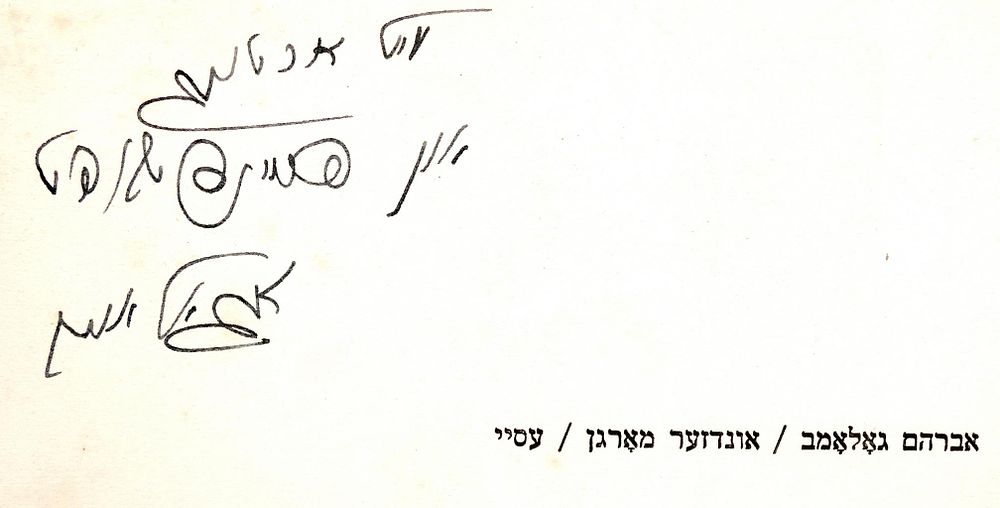
Abraham Golomb, Member of Kultur-lige, Autograph on his Yiddish book “Undzer Morgn” (Our Future, Essay), in Yiddish. Notre Avenir, Essai (Our Future) Inscribed by the author in Yiddish on the frontispiece. Farlag Undzer Kiyum, Paris 1967, 124 pp., Paper covers in dust jacket, 21 x 14 cm. Condition: DJ worn, discolored (yellowing), slightly stained. Spine damaged to top and bottom: 5 & 10 mm. Yellow foxing stains to first pages. Several small worm holes throughout the book in lower corner. Weight: 217 gr. Abraham Golomb (1888 in Lithuania - 1982 in Los Angeles, USA; Yiddish אברהם יצחק גולומב) was a Yiddishist teacher and writer. He wrote many pedagogical articles and books, and also published, primarily in Yiddish, about his belief in the need for retaining Jewish distinctiveness in the Diaspora and the centrality of Hebrew and Yiddish as the languages of the Jewish people. His work has not been widely translated into English. Golomb was affiliated with the Psychology and Education section of YIVO in Vilna, under the direction of Leibush Lehrer, and was also active in the Kultur-lige. From 1921 to 1931, he was the director of the Vilna Teachers Seminary. After living in Palestine from 1932 to 1938, Golomb emigrated to Winnipeg, Canada, where he became principal of the Peretz School. In 1944 he moved to Mexico City, where for 20 years he ran the Yiddish schools. Finally, in 1964 he and his wife Rivke Savich Golomb moved to Los Angeles, California. The Kultur-League (Yiddish: קולטור-ליגע, League of Jewish Culture) was an association of Jewish artists, writers, directors, and publishers, founded in Kiev in early 1918 to develop Yiddish-language culture. The organization included various sections: educational, publishing, library, music, theater, literature, and art. In 1918, Kultur-League branches were established in nearly one hundred cities and towns across Ukraine. Then, from the end of 1918, branches of the Kultur-League's art section were founded in a number of cities: Moscow, Riga, Warsaw, Vitebsk, Petrograd, Crimea, Minsk, Grodno, Vilnius, and Bialystok. In April 1918, the founding meeting of the Kultur-League was held, and the foundation was laid for the creation of two governing bodies: the Central Committee and the Executive Bureau. Moses Zilberfarb, the first Minister of Jewish Affairs in the government of the Central Rada of Ukraine, was elected head of the Executive Bureau. Members and participants of the organization included Alexander Tyshler, Mark Epstein, Issachar-Ber Rybak, Boris Aronson, Nisson Shifrin, Joseph Elman, Isaac Rabinovich, Marc Chagall, El Lissitzky, Abram Manevich, Solomon Nikritin, Sarra Shor, Joseph Chaikov, David Hofstein, Peretz Markish, Leib Kvitko, Chaim Shloime Kazdan, Avrom Golomb, Moses Beregovsky, Mikhail Milner, and others. Artists who were members of the Kultur-League were among the first in Kyiv to use abstract elements in book illustrations. In the second half of 1920, the Soviet government dissolved the Central Committee of the Kultur-League and established its own Organizational Bureau in its place, where almost all members were communists. Almost all of the Kultur-League's institutions were forcibly confiscated by the Soviet government and transferred to the People's Commissariat of Education. Formally, it can be said that the Kultur-League continued to exist until 1924 (as a member of the Soviet European General Committee), but after the Kultur-League's closure, many Jewish artists left the USSR and worked in Europe and America. - Abraham Golomb, Member of Kultur-lige, Autograph on his Yiddish book “Undzer Morgn” (Our Future, Essay), in Yiddish.